
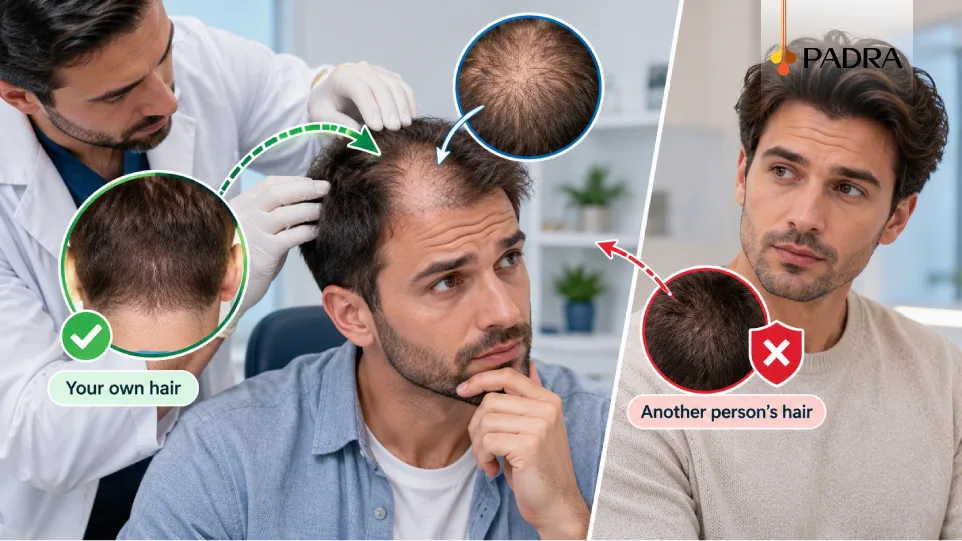
A hair transplant from another person is not a standard treatment. Conventional hair restoration moves living follicles from one part of your own body to another. Follicles taken from somebody else may be recognized as foreign tissue and rejected by your immune system. Rare exceptions have been documented, but they do not make person-to-person donation a routine option.
For people with limited donor hair, the more practical question is whether suitable follicles remain on their own scalp, beard or body, or whether a nonsurgical approach would be more appropriate.
Can Hair Follicles Be Transplanted From Another Person?
In unusual medical circumstances, yes. In ordinary hair transplantation, the patient’s own follicles are used. A standard transplant is called an autograft: follicles are moved from a donor region, commonly the back or sides of the scalp, to an area with thinning hair. FUE extracts individual follicular units; it redistributes existing follicles rather than creating new ones.
Using follicles from another person is an allograft. This involves living donor tissue with its own cellular characteristics, unlike the patient’s own follicles. Even a strand of healthy-looking hair is not interchangeable with a living follicle: cut hair cannot simply be implanted and expected to regrow. The NHS hair-transplant guide describes conventional surgery using the patient’s own donor hair.
This distinction matters when someone hopes to use a relative’s abundant hair to compensate for their own sparse donor area. The obstacle is not only surgical extraction. It is also whether the recipient’s immune system will tolerate the graft. A strand of hair and a follicle are not the same thing: wigs can use donated hair without requiring that donated tissue survive inside another person’s scalp.

Why Is Hair Transplantation Between Two People Difficult?
Immune compatibility is the central barrier. Human leukocyte antigen (HLA) proteins help the immune system distinguish the body’s cells from foreign tissue. Differences between donor and recipient can provoke an attack on transplanted follicles. The British Society for Immunology explains how tissue matching and rejection shape transplantation between people.
With an autograft, the body generally recognizes its own follicles. With an allograft, matching becomes relevant, and even close tissue compatibility does not make routine hair transplantation risk-free. Hair follicles have some immune-privileged characteristics, but this does not make them immune to rejection.
Could immunosuppressive medication make it possible?
Anti-rejection drugs can help certain donated tissues survive, but they suppress immune defenses and may increase risks such as infection, kidney problems and other complications. For an elective cosmetic hair transplant, exposing an otherwise healthy person to long-term immunosuppression would generally be difficult to justify.
A 2023 report in Dermatologic Surgery documented a rare exception: a kidney-transplant recipient received 2,350 hair follicular units from the same unrelated person who had donated his kidney. The recipient was already taking long-term immunosuppressive medication, and the authors reported substantial growth at six to nine months. This is a case report, not evidence that unrelated-donor transplantation is suitable for typical cosmetic patients. The researchers did not establish that matching alone would be enough without the recipient’s existing immune suppression. Their patient had a rare combination of proven donor compatibility and a separate, serious medical reason to take anti-rejection drugs.
Can a Family Member Donate Hair Follicles?
A sibling or parent is not automatically a compatible hair donor. Relatives share some genes, but they do not necessarily have identical HLA markers. Matching blood groups alone also does not demonstrate that a transplant will be tolerated.
In organ and tissue transplantation, relatives can sometimes be closer matches than unrelated donors. That does not turn hair donation into an established procedure, because compatibility, immune suppression and risks to both donor and recipient would still need consideration. The presence of healthy hair on a brother, sister or parent is not enough.
For example, someone with extensive crown loss may have a sibling with thick scalp hair. The sibling’s follicle supply could be abundant, yet those grafts would remain another person’s living tissue. Family relationship is not a substitute for an appropriate donor area on the patient’s own body.
Can an Identical Twin Donate Hair for a Hair Transplant?
An identical twin can be a special exception because genetically identical individuals have unusually close tissue compatibility. Transplantation between genetically identical people is called an isograft, distinct from an ordinary allograft.
A 1988 case report in the Journal of the American Academy of Dermatology described follicle transplantation between identical twins to address a congenital, nonprogressive area of hair loss in one twin. It demonstrates a possibility under specific circumstances, not a routine solution for hereditary baldness.
Both people would still require surgical evaluation, and extracting follicles would use part of the donor twin’s own limited hair supply. A published success in one unusual case cannot predict the outcome or clinical suitability for other identical twins. Even when immune rejection is less concerning, surgeons must still weigh healing, scarring, donor-site appearance and the reasons for treatment in both individuals. This is not a simple arrangement in which a twin supplies unlimited grafts.
What Are the Alternatives If You Don’t Have Enough Donor Hair?
The first step is to evaluate the donor follicles you already have. Not enough scalp donor hair does not always mean that every form of restoration is ruled out. The alternatives below differ in how they work and whether they involve living follicles.
Conservative scalp donor planning
A smaller procedure may prioritize the frontal region or another area where limited grafts could offer meaningful coverage. The surgeon must weigh current density, hair calibre, future thinning and the appearance of the extraction zone. Removing too many grafts can cause visible donor thinning and reduce options later. Extracted follicular units do not regenerate at their original extraction points. A donor area that looks dense at first may also become thinner as hair loss progresses, so both present and future coverage need consideration. The FUE donor-area guide explains why preservation is important.
Beard and body hair transplantation
Selected patients can supplement scalp grafts with their own beard or body follicles, sometimes taken from beneath the chin or from the chest. This is still an autograft, not hair donation from someone else. A peer-reviewed review of nonscalp hair transplantation describes its use when scalp supply is limited, while emphasizing patient selection.
Beard hair is often coarser, and chest or other body hair can differ in length, growth cycle and texture. Matching these characteristics to the recipient area matters; results are less predictable when donor hairs are poorly suited. A beard hair transplanted to the scalp can retain properties that make it visually different from surrounding scalp hair. This is why doctors may favor selected placement rather than using every available nonscalp follicle. Read more in the body hair transplant guide.
Medical and nonsurgical alternatives
When active follicles remain, diagnosis-specific treatment may help preserve hair or improve density in selected patients. Options depend on the cause of thinning and should not be presented as a way to manufacture additional donor grafts. The overview of hair-loss treatment options explains how medical approaches differ from surgery.
If surgery is unsuitable, scalp micropigmentation can create the appearance of density, while a hair system can provide visible coverage without transplantation. Neither creates new follicles, but both may offer a more realistic cosmetic result than overharvesting a weak donor area.
Could laboratory-grown follicles change the options?
Potentially, but laboratory expansion is still experimental. In July 2026, researchers at Brazil’s University of Campinas (Unicamp) described a method starting with approximately 50 to 120 follicles from the patient’s own body, aiming to produce a larger number of viable follicles through laboratory processes.
The university described the technology as preclinical. It has not established reliable, lasting results in routine human transplantation, and it is not a treatment currently available as a standard alternative. Importantly, it aims to expand the patient’s own follicle supply, not make another person’s follicles immune-compatible.
Who Should You Consult If Your Donor Area Is Limited?
Consult a qualified hair-restoration surgeon or dermatologist before assuming that donor shortage makes transplantation impossible. They should first identify the cause of hair loss. Pattern thinning, diffuse loss and inflammatory or scarring conditions require different assessment and planning.
A useful consultation should cover:
· Donor quality: Density, hair calibre, miniaturization and signs of ongoing loss.
· Treatment suitability: Whether even a limited procedure would preserve enough donor supply.
· Alternative sources: Whether your own beard or body follicles match the scalp’s needs.
· Long-term planning: What happens if existing scalp hair continues to thin.
· Nonsurgical options: Whether medical care or cosmetic coverage is a better fit.
Ask who will evaluate the donor area, plan the graft count and perform the surgical stages. The ISHRS position statement stresses appropriately qualified medical responsibility for hair-restoration surgery. A professional may recommend a smaller transplant, treatment first or no surgery at all; none should be framed as a guaranteed result.
Hair transplantation from another person is not a routine answer to insufficient donor hair. Immune rejection remains a major barrier, and documented exceptions involve unusual genetics or medical histories. For most patients, realistic planning starts with their own follicles and suitable nonsurgical alternatives.