
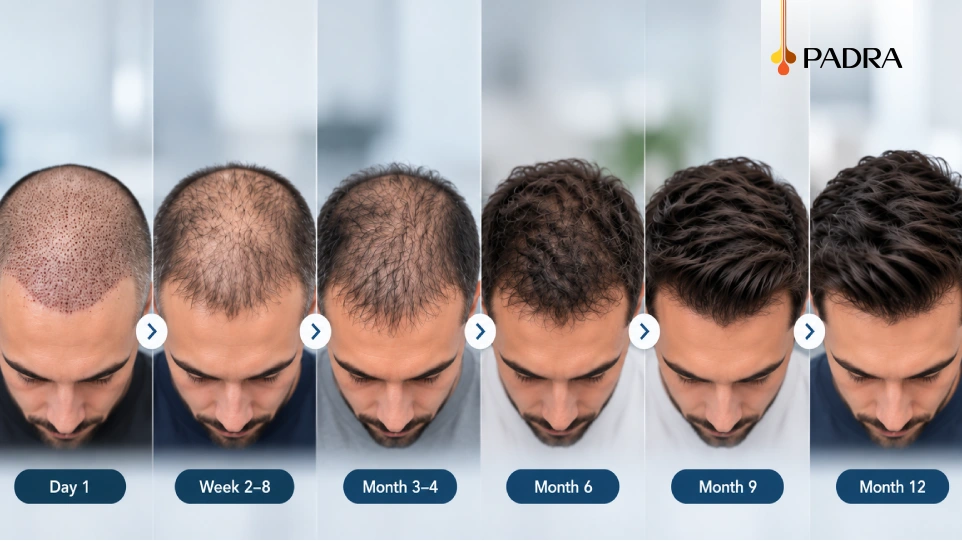
The scalp can look settled well before transplanted hair looks full. In between, hairs may fall out, growth may seem to pause, and one area may develop faster than another. Understanding the hair growth cycle after hair transplant procedure helps explain that gap between healing and visible results.
After a hair transplant, the follicles still follow a cycle of active growth, transition and rest, with a separate shedding process. Early new hairs often become noticeable around three to four months, while the fuller appearance develops over the months that follow. These are approximate milestones, not deadlines for every follicle.
Scalp Healing and Hair Growth Follow Different Timelines
The hair transplant recovery timeline describes how the treated skin heals and when everyday activities can be resumed. The hair transplant growth timeline describes the later appearance of new hair. A scalp that feels more comfortable is not necessarily ready for every activity, and healed-looking skin does not mean the final density should already be visible.

There is also a difference between the follicle and the hair shaft. The follicle is the living structure within the skin that produces hair. The shaft is the strand you can see. A transplanted shaft can shed while its follicle remains in the scalp and later produces another hair. Looking at a shed strand alone cannot establish whether a graft survived.
This is why an early photograph can be misleading: the short hairs visible immediately after procedure show where grafts were placed, but they are not a preview of how much mature coverage you will have.
The Hair Growth Cycle After Hair Transplant Procedure
Anagen, catagen and telogen are the three main biological phases. Exogen describes the release of the old hair shaft and is often discussed separately as a fourth stage. Some sources include shedding within telogen; they are describing the same renewal process using slightly different terminology.
| Phase | Typical scalp duration | What happens |
| Anagen | Usually 2–6 years | Active production of a new hair shaft. |
| Catagen | A few weeks | Growth stops and the lower follicle undergoes a short transition. |
| Telogen | About 3 months | The follicle rests; an existing hair may remain in place. |
| Exogen | Variable | The old shaft is released, sometimes overlapping with a new growth cycle. |
These are approximate durations in the natural scalp hair cycle, not fixed stages assigned to months after procedure.
Hair Transplant Timeline
Here’s what you can expect to see and feel in the months after your transplant
Anagen Is the Growth Phase
Anagen is when a follicle actively makes hair. Once a new shaft emerges, it still needs time to gain enough length to contribute to coverage. The first fine hairs you notice after procedure therefore represent the beginning of visible growth rather than a finished result.
Catagen and Telogen Explain the Pause
Catagen is a brief transition out of active growth. Telogen is a longer period of rest. Resting does not mean a follicle has disappeared: the renewal cycle includes pauses as well as growth. An apparently unchanged patch of scalp, however, cannot be used at home to identify the exact phase of each follicle.
Exogen Is the Shedding Process
Exogen concerns the release of the old strand. It helps explain why losing a visible hair and losing its follicle are different events. For more detail on the normal cycle outside procedure, see Padra’s guide to the four stages of hair growth.
Transplantation Can Interrupt the Usual Pattern
Procedure moves existing follicular units to a new location; it does not make every follicle grow immediately. The procedure can temporarily disturb hair production and trigger shedding. As growth resumes, the transplanted follicles do not all become visibly active together.
It is tempting to label the first postoperative month “catagen,” the second “telogen” and the third “anagen.” That is too rigid. Early postoperative shedding can involve disruption of anagen as well as telogen-related changes. A published case series documented anagen shedding after other scalp operations, illustrating why not all early surgical shedding can be explained by a standard telogen timetable. The study was small and was not a universal hair-transplant schedule.
The useful question during follow-up is whether your scalp and growth are progressing appropriately for your procedure. Assigning a phase to every hair from a mirror or photograph will not answer that.
Shedding and Shock Loss After a Hair Transplant
The American Academy of Dermatology explains that transplanted hairs commonly shed between two and eight weeks after procedure. It also notes that hair can look thinner in the third month.
Quote text:
“the transplanted hair will fall out. This is normal.”
Source: American Academy of Dermatology
The term “shock loss” can also describe shedding of existing, non-transplanted hair near the recipient or donor area. A clinical review reports that recipient-site shedding may begin around two to six weeks after procedure. It is often temporary, although severely miniaturized native hairs may not all recover. Transplanted-shaft shedding and loss of surrounding native hair should therefore be assessed separately.
A strand falling during routine washing weeks later is different from an early injury that may dislodge a graft. If the treated area is knocked or scratched and then bleeds, contact your surgical team rather than pulling at the area to check it. Shedding alone proves neither failure nor success. Our guide to hair falling out after a transplant explains these changes in more detail.
The Hair Transplant Timeline Through the Growth Cycle
The following overview connects the stages of hair growth after a transplant with the changes you may actually see. For detailed day-by-day recovery guidance, read the main hair transplant timeline guide.
| Time after Procedure | Common visible changes | How to interpret the stage |
| Days 1–14 | Crusting, redness and sensitivity during early healing. | Protect the grafts and follow your clinic’s washing and activity instructions. |
| Weeks 2–8 | Some transplanted shafts may shed; surrounding hair may also be affected. | Visible hair loss does not by itself establish graft failure. |
| Months 2–3 | Coverage may look sparse, with little obvious new growth. | This is too early to judge the mature result. |
| Around months 3–4 | The first new hairs may become noticeable. | An early start can be subtle and uneven; timing varies. |
| Months 4–6 | More growth may become visible, but coverage remains incomplete. | Assess the direction of progress rather than expecting final density. |
| Months 6–9 | Results are often easier to appreciate. | More visible coverage is still not the same as complete maturation. |
| Around month 12 | A useful checkpoint for a more developed result. | Your clinician can assess growth, coverage and any areas of concern. |
| Up to 18 months | Further development may occur in some patients. | The NHS gives roughly 10–18 months for full results; individual review remains important. |
Approximate patient guidance, not a guaranteed schedule or a growth-percentage chart.
Three Months Is an Early Checkpoint
At three months, you may still be waiting for clear regrowth. Small new hairs can be difficult to distinguish from stubble or existing fine hair, particularly in photographs. A sparse appearance at this point does not establish the eventual density. Discuss what your own clinic expects at this visit rather than comparing your scalp with someone else’s later result.
Six Months Shows Progress Rather Than a Final Verdict
At six months, the useful comparison is with your earlier photographs. Look at whether coverage is developing in the planned areas and bring persistent gaps to your follow-up. Avoid claims such as “everyone has 50% growth by six months”: a fixed percentage cannot be read reliably from an ordinary photograph.
Twelve Months Allows a More Developed Assessment
A twelve-month review offers more information than the first few months, but the hair transplant results timeline is not identical for everyone. The NHS’s broader ten-to-eighteen-month range is a reminder that maturation may continue. This does not mean an unexplained lack of progress should be left unassessed until month eighteen.
Uneven Growth and the Development of Density
Visible density is influenced by the number of growing hairs and their shaft diameter, not simply by the number of grafts placed. Research on the Hair Diameter Index examines this relationship between hair count, caliber and visual coverage. Longer hairs can also overlap neighboring areas, so a fuller appearance does not mean new follicles are being created.
Patchiness in early photographs needs context. Hair length, styling, lighting and the proportion of hairs that are visibly growing can change how much scalp is exposed. One side looking fuller in a photograph is a reason to compare consistent images and discuss progress, rather than proof that the other side has failed.
The crown should be assessed as its own treatment area. A crown that still looks open while the hairline looks fuller does not by itself demonstrate a slower biological cycle. Ask the team to evaluate its coverage against the area treated, graft allocation and your serial photographs; do not assume every crown must finish on a separate fixed timetable.
The Factors Behind Different Results
A fair comparison starts with the baseline: the size of the thinning area, donor-hair characteristics, graft distribution and scalp condition. Graft handling, healing and continued loss of native hair also affect assessment. Health problems or deficiencies can influence the underlying cycle. Aftercare matters, but it is not the only factor determining the pace of regrowth or the amount of coverage achieved.
Donor Area Healing and Regrowth
The donor area has two separate issues: healing of the extraction sites and the appearance of the remaining hair. After FUE, small extraction sites usually form crusts, which commonly clear over roughly one to two weeks with the prescribed care. Redness, sensitivity or altered sensation may settle at different rates, so the disappearance of crusts is not a complete assessment of recovery.
A follicular unit that has been fully removed does not normally grow back at its original extraction site. It has been moved to the recipient area. The hair left around those sites can grow longer and improve camouflage. Temporary shedding of surrounding donor hair may also recover; this should not be confused with replacement of the harvested follicles.
Persistent donor patchiness deserves an examination. A photograph alone cannot determine whether it reflects a short haircut, temporary shedding, scarring or excessive harvesting.
FUE and DHI Share the Same Growth Biology
FUE describes harvesting follicular units individually. DHI generally refers to an implantation approach involving an implanter; it can be used with FUE harvesting. The ISHRS distinguishes donor-harvesting methods from implantation methods.
These terms do not identify different hair-cycle phases or establish that one approach always produces earlier regrowth. Recovery depends on the actual procedure, its extent, tissue handling and your healing. Ask what was done and how it affects your aftercare rather than choosing a recovery deadline from the technique’s name.
Supporting Growth and Measuring Progress
The early priority is to protect the treated skin. Follow the surgical team’s instructions for cleansing, crust care, exercise, sun exposure and scalp products. Do not pick at crusts, test grafts by pulling on hairs or introduce vigorous massage to try to stimulate growth. Padra’s hair transplant aftercare guide provides further context; your own postoperative instructions take priority.
Medication has a separate role. A transplant does not stop ongoing loss of non-transplanted hair. If treatment such as minoxidil or finasteride is appropriate, your clinician should decide suitability and when to start or resume it. Supplements are most useful when they address an identified deficiency; taking more vitamins does not establish that transplanted hair will grow sooner. Additional treatments, including PRP, need their own assessment and should not be presented as mandatory for every patient.
To track visible progress during the hair growth cycle after hair transplant procedure, take photographs at agreed intervals using similar lighting, camera distance, angles, hair length and styling. Include the donor area as well as the front, top and crown. Note the date and any scalp symptoms. Monthly comparisons are generally more useful than checking the mirror repeatedly each day.
When looking at hair transplant before and after results, check the time since procedure and whether the original hair-loss pattern resembles yours. A twelve-month photograph is not a reasonable benchmark for a three-month scalp.
When Progress Needs a Clinical Review
Keep the follow-up appointments your team recommends, even if healing appears straightforward. If little or no regrowth is apparent around four to six months, ask the clinic to review it. That timing alone does not diagnose failure, but an examination is more helpful than repeated reassurance based only on a generic timeline.
Contact the clinic promptly for severe or increasing pain, spreading redness, pus, fever, persistent bleeding or an unexpected change in the treated skin. These symptoms should not be explained away as a normal growth phase. Ongoing heavy shedding, new thinning outside the treated area, or donor gaps that are not improving also warrant assessment.
re unsure about what you are seeing, share dated photographs and your symptoms with your treating team. The aim of follow-up is to understand your progress and address concerns while the result develops, not simply to count the months since procedure.