
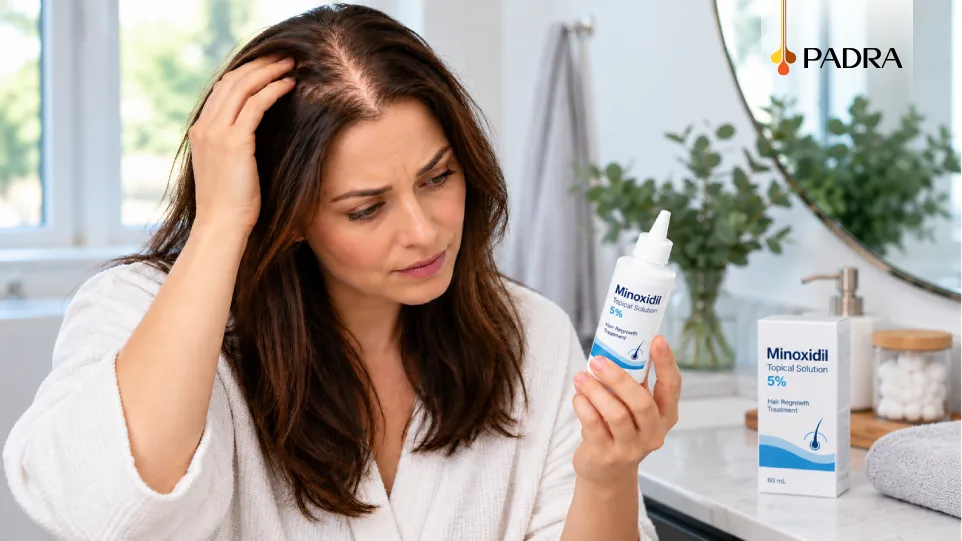
Topical minoxidil can help some women with female pattern hair loss maintain hair and improve scalp coverage, but it does not work for every cause of thinning. Women’s 2% solution and 5% foam have different application instructions. A men’s product should not be substituted simply because it contains minoxidil.
Does Minoxidil Work for Women?
Yes, topical minoxidil can improve hair density in some women with female pattern hair loss (FPHL), also called androgenetic alopecia. Benefits vary.
FPHL often appears as a widening part or reduced coverage over the central scalp and crown. Minoxidil may help follicles remain in the growth, or anagen, phase longer. Its full mechanism in hair regrowth is still not completely understood. See Padra’s topical minoxidil guide for general information.
How Effective Is Minoxidil for Female Hair Loss?
Clinical evidence supports benefit, not a universal success rate. In a randomized trial involving 404 women with FPHL, once-daily 5% foam improved target-area hair counts more than inactive foam at 24 weeks. It does not predict individual cosmetic results.
What Types of Female Hair Loss Can Minoxidil Help?
Minoxidil has its clearest established role in FPHL, not every condition described as alopecia. Sudden patches, postpartum shedding or scalp pain suggest other causes.
Traction alopecia involves repeated pulling on the hair; scarring alopecia can permanently damage follicles. Alopecia areata is an immune-mediated condition. Minoxidil might be used alongside other treatments in selected cases, but it cannot replace diagnosis-specific care or restore destroyed follicles.
The British Association of Dermatologists’ FPHL guidance explains why recognizing the pattern matters.

Can Women Use Minoxidil for Men?
Women can use minoxidil, including products formulated at 5%, but a men’s label is not interchangeable with a women’s label. Strength, vehicle, directions and approved users can differ.
For example, U.S. women’s 5% foam is labeled once daily, while a men’s 5% product may carry different instructions. Men’s 5% solution labels can explicitly say not to use the product if you are a woman. This is a product-label restriction, not proof that all 5% minoxidil is inappropriate for women.
Compare concentration, ingredients, directions and local labeling. Ask a pharmacist or clinician rather than copying a men’s dosing schedule.
Why Do Some Minoxidil Products Say “Not for Women”?
That wording reflects the authorization and testing behind the specific product, including its intended users and instructions. It should not be interpreted as saying minoxidil changes female hormones. Women’s 5% foam products exist with their own approved labeling.
Which Minoxidil Is Better for Women: 2% Solution or 5% Foam?
Neither is automatically best for every woman. Frequency, scalp tolerance and consistency matter.
These are examples from specific U.S. labels, not universal instructions.
A 2016 trial compared once-daily 5% foam with twice-daily 2% solution in women with FPHL. Both groups gained hair, but the study did not meet its prespecified noninferiority criterion, so it should not be used to claim that one option is unquestionably superior or equivalent.
What About Oral Minoxidil?
Oral minoxidil is a prescription tablet with greater systemic exposure than topical treatment. Its use for hair loss in the U.S. is off-label and requires medical evaluation rather than self-directed dosing.
See oral minoxidil for hair loss and the separate guide to oral minoxidil side effects.
How to Use Minoxidil for Women
Apply the measured, label-directed amount to the scalp rather than coating the hair strands. The exact steps depend on whether you have foam or solution.
-
Check your product. Confirm that it is intended for you, including strength, frequency and measuring device.
-
Start with a dry, healthy scalp. Do not apply over inflamed, infected, painful or damaged skin.
-
Part of the hair. Expose the thinning area and place the measured solution or foam directly on the scalp. Move the part as needed, using the total amount for one application, not a fresh dose for every part.
-
Spread gently. Avoid the forehead, cheeks, eyes and other body areas, where transfer can cause unwanted hair growth.
-
Wash your hands and let the scalp dry. Allow the preparation to dry before lying down or adding styling products. Follow the product’s washing and flammability precautions.
How Often Should Women Apply Minoxidil?
For the two specified U.S. products, 2% women’s solution is labeled as 1 mL twice daily, while 5% women’s foam is labeled as half a capful once daily. Other labels may differ. Extra product does not speed results.
Quote text:
“using more or more often will not improve results”“using more or more often will not improve results”
What If You Miss a Dose?
Follow your particular label; do not double the next application to make up for one you missed.
How Long Does Minoxidil Take to Work for Women?
Some women notice early changes after several months; judging meaningful improvement takes longer. Timelines vary by formulation and person.
The American Academy of Dermatology (AAD) recommends allowing about six to 12 months to judge effectiveness.
Follow your specific product’s earlier stop-and-consult instructions: the cited women’s 2% solution label says to stop and ask a doctor if no regrowth appears after four months; the cited 5% foam label says six months.
Will Hair Growth Last If Minoxidil Is Stopped?
Benefits can diminish after stopping, allowing the underlying thinning pattern to become more noticeable again. No tapering method guarantees preservation of regrowth.
See stopping minoxidil in women for a focused discussion.
Is Minoxidil Safe for Women?
Topical minoxidil can be appropriate for selected women when used according to the correct label, but it is not risk-free. Women who are pregnant, planning pregnancy or breastfeeding should avoid it and seek medical guidance. Labels also advise against self-treatment for sudden, patchy, unexplained or childbirth-associated shedding, or on an irritated scalp.
Possible effects include itching, dryness, flaking, redness and unwanted facial hair growth. Stop using the product and seek medical advice for persistent scalp irritation, rapid heartbeat, dizziness, chest pain, swelling or sudden unexplained weight gain. Urgent symptoms need prompt care.
Does Minoxidil Work for Different Groups of Women?
The diagnosis matters more than a demographic label. Consider these differences:
-
Black women: FPHL may respond, but traction alopecia and central centrifugal cicatricial alopecia (CCCA) have different mechanisms and treatment priorities. AAD guidance emphasizes early diagnosis.
-
Women with PCOS: Minoxidil may be considered for pattern thinning, but it does not treat polycystic ovary syndrome itself.
-
Women over 60: FPHL can occur later in life, but other diagnoses, medical conditions and medications deserve review. Results cannot be predicted from age alone.
-
Other alopecias: Patchy, inflammatory or scarring loss needs its own treatment plan; minoxidil should not be assumed to work for every type.
What Do Reddit Experiences Tell Us?
Anecdotes, not clinical evidence. Reddit can reveal questions about routines, shedding and irritation, but users may have different diagnoses or combine treatments. A personal before-and-after post cannot predict your result or establish safety.
What If Minoxidil Does Not Work or Is Not Suitable?
Recheck the diagnosis before assuming you need a stronger product. A dermatologist can review adherence, tolerability and other possible causes. Options may include medical care or surgery in selected candidates. Prescription oral treatment requires its own risk assessment.