







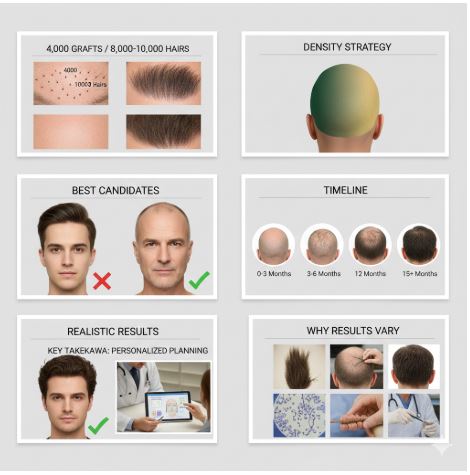
- What 4,000 grafts really mean: About 8,000–10,000 hairs, not equal density for everyone
- Best candidates: Moderate to advanced hair loss, not early thinning
- Realistic results: Strong hairline + cosmetic coverage, not teenage density
- Density strategy: Higher density in front, lighter toward crown
- Timeline: Shedding first, visible growth by 3–6 months, final results at 12–15 months
- Why results vary: Hair texture, skin contrast, donor quality, surgical technique
- Key takeaway: Graft count is a tool—personalized planning delivers the best outcome
If you have been researching hair restoration, you’ve likely seen the number “4,000” more than a few times. It’s often treated as the “sweet spot” for people with significant thinning. But if you are looking at 4000 hair grafts before and after photos, you might notice that two people with the same number of grafts can end up looking completely different.
Why is that? Because a hair transplant isn’t just a numbers game; it’s about how those numbers are used to cover your specific balding pattern. Let’s strip away the clinical jargon and look at what a 4000 grafts hair transplant really does for your appearance.
Understanding What 4,000 Hair Grafts Actually Means
Before we talk about results, let’s clear up one big thing: a graft is not the same as a single hair. Think of a graft as a small “bundle” or family of hairs. One graft might have one hair, or it might have four.
On average, a session of 4000 hair grafts means moving roughly 8,000 to 10,000 individual hairs.
- Success isn’t just the count: It’s the quality. If your hair is thick and coarse, 4,000 grafts will look like a forest. If your hair is very fine, those same 4,000 grafts might look a bit more like a thin veil.
- The Donor Limit: You only have so much hair in the “donor area” (the back of your head). Using 4,000 at once is a big move, so it has to be planned carefully to keep the back of your head looking natural.
Who is the Right Candidate for 4000 Grafts?
This isn’t for someone who just has slightly thinning temples. Usually, a surgeon recommends 4000 hair grafts for people who have reached “moderate to advanced” hair loss. You might be in this group if:
- Your hairline has moved back significantly, creating a large forehead.
- The top of your head (the mid-scalp) is thinning enough to see skin under normal lights.
- You want to fix the front hairline and also add some coverage to the crown hair transplant area.
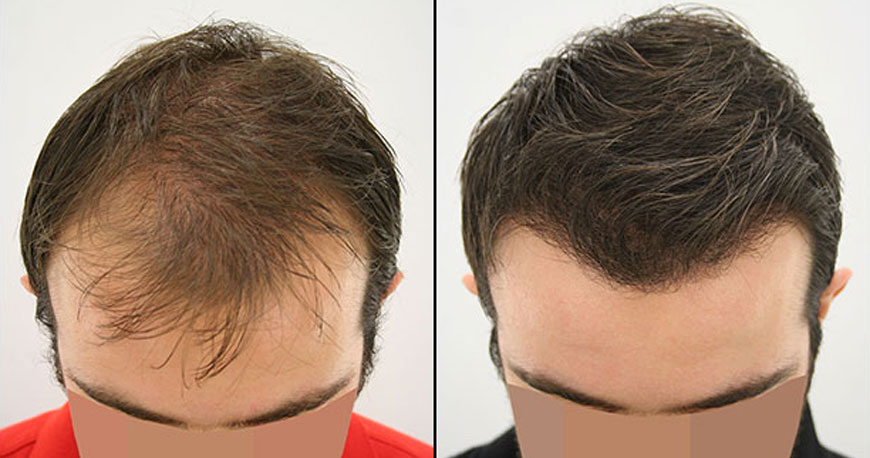
Real Results: What Changes in 4000 Hair Grafts Before and After Photos?
The biggest change you’ll see in 4000 hair grafts before and after shots is the “frame” of the face. When the hairline is restored, it changes your entire silhouette.
However, be careful with what you see online. Some photos look incredibly thick because of:
- Strategic Placement: Putting more hair in the front where it’s most visible.
- Angle of the Photo: A front-facing photo looks thicker than one taken from directly above.
- Hair Styling: Longer hair in the “after” photo can hide gaps that 4,000 grafts alone couldn’t fill.
Want to see real-world expectations? Check out our gallery to see what 4,000 grafts can realistically achieve for hair loss patterns like yours.
The Waiting Game: Timeline of Your Results
You won’t wake up the next day with a full head of hair. In fact, for a few weeks, it might look worse before it looks better. Here is the reality:
- Months 1–2: The “Shock Loss.” Most of the new hair will actually fall out. This is totally normal! The roots are safe; they just need to reset.
- Months 3–6: You’ll see thin, fuzzy new growth. This is when the graft count explanation starts to make sense as you see the coverage area fill in.
- Months 12–15: This is your final result. The hair is thicker, stronger, and can be styled however you like.
Can 4000 Grafts Give You High Hair Density?
This is the most common question: “Is 4000 grafts enough for a thick look?”
The answer is: it depends on the surface area. If you are trying to cover a very large, fully bald hair transplant area, 4,000 grafts will give you “cosmetic coverage” (you won’t look bald), but it won’t be as dense as your hair was when you were 18.
Surgeons use a trick called “graduated density.” They pack the hair tight at the very front and spread it out more as they go toward the back. This makes the hair transplant density look high where people look at you most.
4000 Grafts vs 3500 Grafts — Is More Always Better?
People often wonder if they should push for 4,000 if their doctor recommended 3,500. Usually, the difference is about coverage expansion. Those extra 500 grafts might be used to reach a bit further into the crown or to add a “safety layer” of density behind the hairline.
But remember: your donor area is a limited resource. Taking too many hairs now might leave you with no “spare parts” if you lose more hair in five years.
Why Results Look Different for Everyone
If you and your friend both get a 4000 grafts hair transplant, your results might not match. This is because of:
- Hair Texture: Curly hair covers the scalp much better than straight hair.
- Skin Contrast: Dark hair on pale skin makes thinning more visible.
- Graft Health: How the grafts were handled during surgery matters more than the total count.
Being Honest: What 4000 Grafts Can’t Do
If you are completely bald from front to back, 4,000 grafts will not give you a thick, full mane. It might give you a great hairline and a thin layer on top, but you might need a second session a year later to get the density you really want. It’s a massive improvement, but it’s not magic.
Is 4000 the Magic Number for You?
Graft counts are a tool, not a promise. While 4000 hair grafts before and after transformations can be life-changing, the best result comes from a plan that respects your natural look and your future hair health. Don’t chase the highest number; chase the best strategy for your face.