








A hair transplant does not move directly from surgery to visible growth. The first few weeks are mainly about healing, scab formation, shedding, and protecting the transplanted follicles. New growth generally appears later, with most of the visible change developing over several months.
If you are looking for a hair transplant week-by-week guide, the most important thing to understand is that the way your scalp looks during the first month is very different from the final result. Temporary shedding, uneven growth, and periods with very little visible change can all be part of a normal recovery.
This guide explains what usually happens from the first day through the first four weeks, followed by the key growth stages from month 2 to month 18.
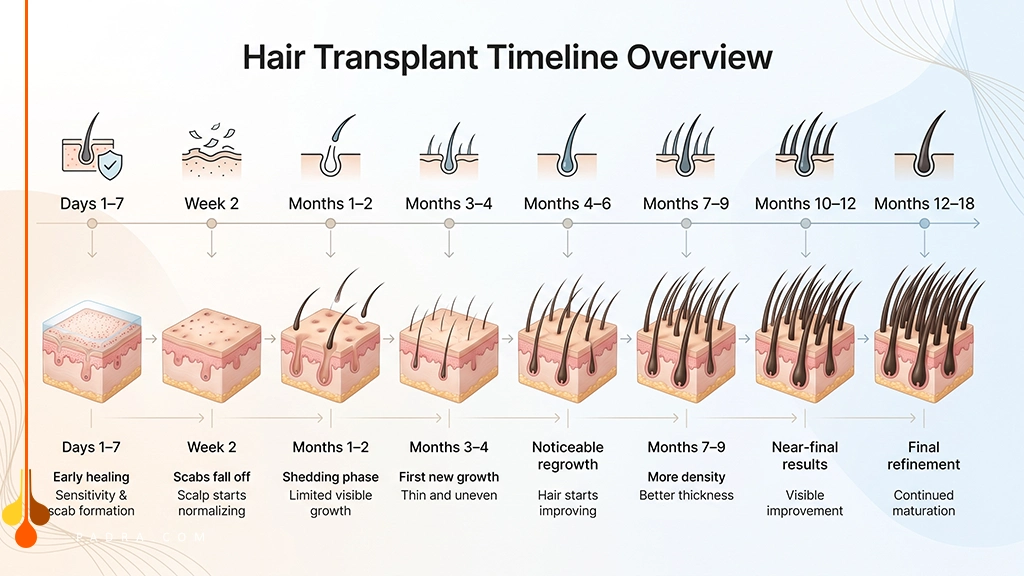
Hair Transplant Timeline Overview
Before going into detail, here is a simplified overview of what usually happens after a hair transplant:
Days 1–7: Early healing, sensitivity, and scab formation
Week 2: Scabs begin to fall off, and the scalp starts to normalize
Months 1–2: Shedding phase and limited visible growth
Months 3–4: First signs of new growth, often thin and uneven
Months 4–6: Noticeable regrowth begins
Months 7–9: Density, thickness, and texture improve
Months 10–12: Near-final results become visible
Months 12–18: Final refinement and continued maturation
This timeline can vary from person to person depending on healing speed, hair type, donor area quality, and aftercare.
Hair Transplant Timeline at a Glance
| Stage | What You May Notice |
|---|---|
| Days 1 to 7 | Redness, sensitivity, swelling, and small scabs |
| Week 2 | Scabs gradually clear and the scalp begins to settle |
| Week 3 | Transplanted hairs may begin shedding |
| Week 4 | Shock loss may become more noticeable |
| Months 2 to 3 | Quiet phase with limited visible growth |
| Months 3 to 4 | Fine, early hairs may begin appearing |
| Months 4 to 6 | Growth becomes easier to see |
| Months 7 to 9 | Density and hair thickness improve |
| Months 10 to 12 | Results become more developed and natural-looking |
| Months 12 to 18 | Continued maturation may occur |
The exact timeline varies between patients. Hair characteristics, donor quality, treatment area, healing response, and individual aftercare can all influence how quickly changes become visible.
Hair Transplant Week by Week: The First Month
Week 1: Healing and Protecting the Grafts
The first week is primarily a healing period.
During the first few days, mild swelling, tightness, redness, tenderness, and small crusts around the transplanted hairs can occur. The donor area may also feel sensitive.
At this stage, appearance should not be used to judge the result. The priority is protecting the transplanted area and following the washing, sleeping, medication, and aftercare instructions provided by your medical team.
Avoid rubbing, scratching, or applying unnecessary pressure to the recipient area.
Washing protocols differ between providers, so your own post-treatment instructions should always take priority.
Week 2: Scabs Clear and the Scalp Settles
By the second week, the scalp usually begins to look noticeably cleaner.
Scabs and crusts generally start loosening as healing progresses. Redness and sensitivity may also reduce, although they can remain visible for longer in some patients.
Do not manually pick at remaining scabs unless your treatment team has specifically instructed you how and when to remove them.
This is also the point when many patients begin feeling more comfortable socially because the most obvious signs of the procedure are becoming less noticeable.
The scalp may look better, but the growth stage has not started yet.
Week 3: Shedding Can Begin
Week 3 is where the recovery journey can become confusing.
The transplanted hairs that were visible immediately after surgery may begin falling out. This is commonly referred to as post-transplant shedding or shock loss.
The important distinction is that losing the visible hair shaft does not necessarily mean the transplanted follicle has been lost.
Temporary shedding in the weeks following a hair transplant is widely recognized as part of the normal recovery process. The American Academy of Dermatology notes that transplanted hairs commonly shed between approximately two and eight weeks after surgery.
For many patients, this stage looks worse before it looks better.
Week 4: The Quiet Phase Begins
By the end of the first month, the scalp may look largely healed while the transplanted area appears thinner than expected.
Some patients even feel that they have returned to their pre-transplant appearance.
This is usually too early to evaluate density.
The transplanted follicles may enter a resting period before producing new visible hairs. Existing native hairs around the treated area can also temporarily appear thinner in some cases.
The first month is therefore better viewed as the end of early recovery, not the beginning of the final result.
Want to Know What Your Own Timeline Could Look Like?
Your donor area, hair characteristics, graft requirements, and treatment plan can all influence the way recovery and growth progress.
Months 2 to 3: The Waiting Stage
Months 2 and 3 can test a patient’s patience.
The scalp usually appears healed, but there may still be very little visible growth. This does not automatically indicate a problem.
Some follicles remain in a resting phase before beginning a new growth cycle.
Around month 3, some patients start noticing the first fine hairs. Others may need more time.
These early hairs can initially look soft, thin, light, or uneven. They should not be judged as the final texture or density.
Months 3 to 4: The First New Hairs
This is often where the first visible signs of regrowth begin.
New hairs can appear gradually rather than all at once, so one area may initially grow faster than another.
The first growth can resemble fine or baby-like hair. Over time, these strands typically become stronger, thicker, and more noticeable.
The American Society of Plastic Surgeons notes that new growth may begin after the early shedding period, while the AAD places the first meaningful visible results several months after the procedure.
The keyword at this stage is progress, not density.
Months 4 to 6: Visible Growth Begins
Between months 4 and 6, the visual change usually becomes easier to notice.
More transplanted follicles may enter active growth, the hairline can become clearer, and coverage begins improving.
The newly growing hairs may still vary in thickness and texture. Some may look finer than the surrounding hair at first.
This does not mean that they will remain that way. Hair maturation continues over the following months.
Photos taken under consistent lighting can be more useful than checking the mirror every day because gradual changes are easier to recognize over time.
Months 7 to 9: Better Density and Texture
For many patients, months 7 to 9 are when the transplant begins to feel much more established.
The hair generally becomes longer and thicker, coverage improves, and the transplanted area can blend more naturally with surrounding hair.
Styling may also become easier.
However, this is still not necessarily the final result. Areas such as the crown may mature more slowly than the frontal hairline.
Avoid comparing your exact month 7 or month 8 appearance with another patient’s photographs. Hair calibre, curl, donor characteristics, graft numbers, treated area, and individual growth cycles all affect perceived density.
Months 10 to 12: A More Mature Result
By months 10 to 12, many patients can evaluate the overall shape and coverage much more clearly.
Hair shafts have had more time to mature, and the hairline typically looks better integrated with existing hair.
The AAD states that many patients see results between six and nine months, while some require around 12 months. Other clinical guidance notes that maturation can continue for longer.
That is why the first anniversary is a useful milestone, but not an absolute deadline for every patient.
Reference: American Academy of Dermatology
Months 12 to 18: Final Refinement
Some hair transplants continue improving beyond the first year.
Further changes may include increased shaft thickness, better texture, improved coverage, and more natural blending with surrounding hair.
The crown can be particularly slow to mature.
NHS guidance places the full-result window broadly between 10 and 18 months, reinforcing why patients should avoid judging a transplant too early.
What Is Normal During Hair Transplant Recovery?
Several changes can be normal at different stages of the timeline:
- Temporary redness or swelling during early healing
- Small scabs around transplanted hairs
- Shedding during the first several weeks
- Limited visible growth in months 1 to 3
- Fine or uneven early regrowth
- Different growth speeds across the scalp
- Gradual improvement rather than immediate density
Recovery should always be considered in context. Your treating team knows the number of grafts, treatment area, technique, and details of your procedure.
When Should You Contact Your Doctor?
Some symptoms deserve professional assessment rather than waiting for the next stage of the timeline.
Contact your medical team if you develop increasing or severe pain, heavy or persistent bleeding, pus or other signs of infection, fever, worsening swelling, or another unexpected symptom.
The NHS advises contacting the treating provider if severe pain or unexpected symptoms develop after a hair transplant.
If you are simply concerned that growth looks slower than expected, your team can compare your progress with your treatment plan and recovery stage.
Does FUE Have a Different Timeline?
The overall hair growth cycle after FUE follows the same broad pattern of healing, temporary shedding, resting, regrowth, and maturation.
The main differences between procedures are often seen in the donor area’s early recovery rather than in how quickly transplanted follicles ultimately produce mature hair.
Patients considering an FUE hair transplant should therefore discuss both donor-area healing and the longer growth timeline before treatment.
What Can Affect Your Hair Transplant Timeline?
There is no single calendar that applies perfectly to every patient.
Factors that may influence the appearance and pace of recovery include:
- Hair thickness and texture
- Donor-area characteristics
- Size and location of the transplanted area
- Number of grafts
- Individual healing response
- Existing hair-loss pattern
- Scalp health
- Adherence to aftercare instructions
The result should be evaluated as a progression rather than against one exact date.
Final Thoughts
The most important thing to remember about a hair transplant timeline is that recovery and growth are two different processes.
The first few weeks are about healing. The following months are about follicle cycling, new growth, increasing thickness, and gradual maturation.
A hair transplant week-by-week guide can help you understand what usually happens, but it should not become a strict deadline for judging your own progress.
Follow your individual aftercare instructions, document your progress at regular intervals, and speak with your medical team whenever something feels unusual rather than comparing your recovery with someone else’s timeline.