
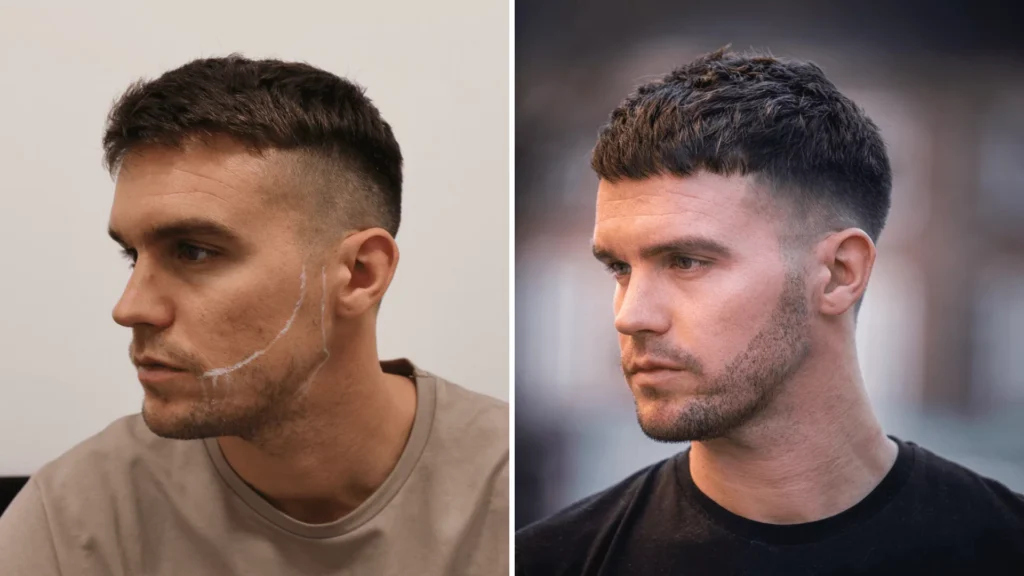
- Beard Transplant Before and After: A 12-month process, from initial redness to a full, natural beard.
- The “Ugly” Phase: Expect redness, scabs, and shedding during the first 3 months.
- Quality Photos: Look for natural angles, symmetry, and consistent hair direction.
- Donor Health: Healthy donor areas show no over-harvesting.
- Red Flags: Beware of “too perfect” photos with unrealistic timelines or missing donor images.
When you first start thinking about fixing a patchy beard, the first thing you probably do is hop on Google or Instagram. You spend hours scrolling through beard transplant before and after pictures, amazed at how some guys go from a completely bare face to a thick, rugged look. It feels like a total transformation.
But here is the catch: those beard transplant before and after photos only tell half the story. If you are serious about changing your look, you need to know what happens between those two shots. Seeing the final result is great, but understanding the procedure is what will actually help you get the best outcome for yourself.
Why You Shouldn’t Just Trust Every Beard Photo You See
It’s natural to rely on visual proof. Most men use before and after beard transplant galleries to decide which clinic to trust. However, there is a big gap between “marketing photos” and “medical reality.”
A photo can show a beautiful result, but it doesn’t always show if the hair feels natural or if the skin underneath is healthy. To get a real sense of what to expect, you have to look past the surface-level image.
Beyond the Hair: What a Good “After” Photo Actually Reveals
When you are looking at beard transplant before and after pics, you need to be a bit of a detective. Don’t just look at the “fullness.” Look at the technical details:
- The Outline: Does the cheek line look natural, or is it too straight and “fake”?
- Symmetry: Do the left and right sides match up in a way that fits the face?
- Hair Direction: This is the most important part. Unlike the hair on your head, beard hair grows at very sharp angles. A good “after” photo shows hair that grows downward, not pointing out like needles.
Get a Professional Evaluation
Compare your beard pattern with real patient outcomes. See similar cases and understand your potential results.

The Growth Timeline: When Will You Actually See Your New Beard?
The most common mistake men make is thinking the change happens overnight. The beard transplant surgery before and after the process is a marathon, not a sprint.
Days 1–7: The “Scabby” Stage No One Talks About
Immediately after the procedure, your face won’t look like a beard model’s. You will see redness, tiny scabs around each graft, and some swelling. This is the “raw” phase. It’s a normal part of healing, but most clinics don’t put these photos on their front page.
Months 1–3: The “Shedding Phase” (Don’t Panic!)
This is where many guys get nervous. The hair that was just transplanted will actually fall out. This is called “shock loss.” If you saw beard hair transplant before and after photos at the two-month mark, the patient might actually look worse than they did before the surgery. Don’t worry—the roots are safe and just resting.
Months 6–12: The Final Reveal and Real Density
By the six-month mark, the hair starts growing back for good. By one year, you are finally seeing the full beard transplant before and after transformation. The hair has softened, the density is settled, and you can finally style it properly.
Getting a Full Beard Transplant: Can You Really Go from Patchy to Thick?
A full beard transplant before and after the result is usually the goal, but it depends on your “donor hair.” Most surgeons take hair from the back of your scalp. If your scalp hair is thick, your beard will likely look thick. If you have fine hair, your beard will look more like natural stubble. It’s all about working with what you have.
The Secret to Natural Density: Why Fewer Grafts Can Sometimes Look Better
It’s not always about the number of hairs; it’s about where they are placed. In many beard hair transplant before and after cases, a surgeon will place more hair in the goatee area and use a lighter touch on the cheeks. This “strategic density” makes the beard look natural rather than like a wig attached to the face.
Considering a Beard Transplant in Turkey? What the Photos Won’t Tell You
You’ve likely seen the ads for a beard transplant turkey before and after. Turkey is famous for these procedures because they are affordable, but results can vary.
- Quality Over Quantity: Some clinics focus on “high graft counts” but ignore the angle of the hair.
- Clinic Standards: Always look at beard transplant clinic before and after photos specifically from the doctor who will perform your surgery, not just general “clinic” photos.
Common Tricks: How Lighting and Styling Can Change a “Before and After” Story
Be careful when evaluating beard transplant before and after images. Some “cheats” include:
- Lighting: Dim lighting can hide gaps in a thin beard.
- Beard Fibers: Some “after” photos use cosmetic powders to make the beard look darker and thicker.
- The Trim: A beard that is trimmed to a specific length (usually 3–5mm) often looks much denser in photos than a long, wispy beard.
How to Judge Professional Beard Photos Like an Expert
When you browse a beard transplant surgery before and after gallery, look for:
- Multiple Angles: You should see the front, the left profile, and the right profile.
- The Donor Area: A responsible clinic shows a beard to scalp hair transplant before and after the back of the head to prove they didn’t leave a scar or over-harvest the hair.
- Consistent Quality: The “before” and “after” should have the same background and lighting.
Why Your Beard Result Might Look Different from the Photos
Every man heals differently. Your beard transplant before and after result will be unique to you because of:
- Skin Type: Some skin heals faster and with less redness.
- Hair Color: Dark hair on light skin looks thicker than blonde hair on light skin.
- Hair Curl: If your hair has a natural wave, it will cover more surface area on your face.
Plan Your Transformation
Get a personalized growth and cost estimate based on your facial structure and donor hair. Stop guessing—get the facts.
Red Flags: When a Before and After Result Is Probably Too Good to Be True
If you see beard transplant before and after pics that look “too perfect,” watch for these warning signs:
- The “after” photo is shown only 2 months after surgery (this is biologically impossible).
- The hairline is perfectly straight, like it was drawn with a ruler.
- There are no photos of the donor area on the back of the head.
How to Use Photos to Plan Your Own Transformation
Ultimately, beard transplant before and after photos should be a tool for communication, not a guarantee. Use them to show your surgeon the type of shape and density you like.
Remember, the best result isn’t a “perfect” beard from a magazine—it’s a beard that makes you feel more confident every time you look in the mirror. Focus on finding a clinic that is honest about the timeline and realistic about what can be achieved with your specific hair type.
Would you like me to help you create a list of questions to take to your first consultation to see if a clinic’s results are actually authentic?