
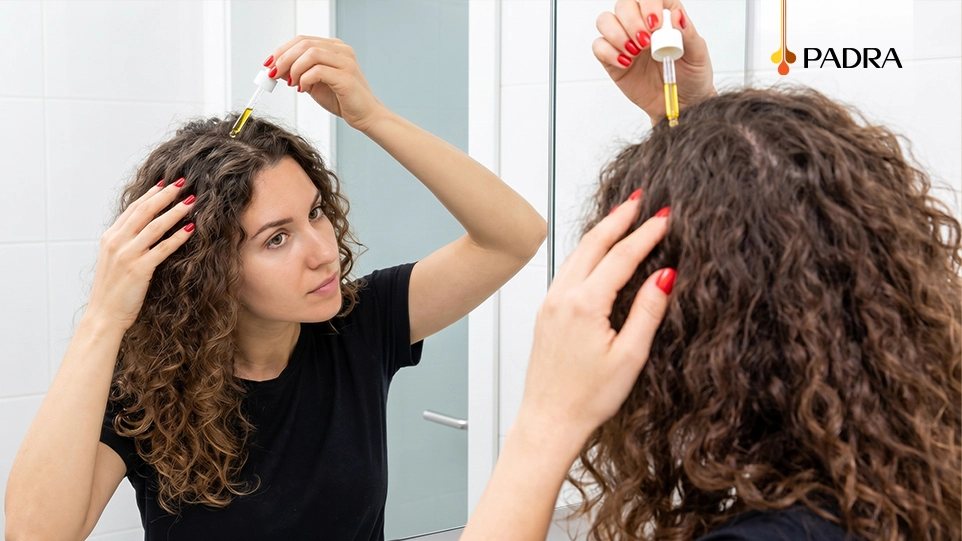
Choosing the best hair growth oil for natural hair is not simply about finding the oil that promises the fastest growth. Natural, curly and coily hair can continue growing from the scalp while dryness, tangling and breakage prevent that growth from becoming visible as length.
This is especially common with curly and tightly coiled textures. The bends along each strand can make it harder for natural scalp oils to reach the ends, leaving the oldest parts of the hair more vulnerable to dryness and breakage.
That is why a good oil for natural hair may have different jobs. Some oils are better suited to scalp-focused routines, while others help reduce frizz, protect dry ends, improve softness or support length retention.
Below, we compare 10 natural hair oils and explain which options may work better for curly, coily, frizzy, fine or very dry hair.
What Is the Best Oil for Natural Hair?
There is no single best oil for natural hair because different oils solve different problems.
If your curls become greasy or weighed down easily, lighter oils such as jojoba, grapeseed and argan may be easier to use. Very dry, coarse or tightly coiled hair may tolerate richer oils such as avocado, coconut or castor oil.
If your main concern is the scalp rather than the hair shaft, diluted rosemary oil is commonly used in growth-focused routines. However, most natural oils are better understood as conditioning or protective ingredients rather than proven treatments for hair loss.
| Main concern | Oils to consider |
|---|---|
| Scalp-focused routine | Rosemary + jojoba or grapeseed |
| Fine curls | Jojoba, grapeseed, argan |
| Frizz | Argan, jojoba |
| Very dry natural hair | Avocado, coconut, olive |
| Coily or coarse hair | Castor, avocado |
| Dry or fragile ends | Coconut, sweet almond, argan |
| Breaking a curl cast | Grapeseed, jojoba, argan |
Natural Hair Growth vs Length Retention
One of the most important things to understand about natural hair growth is the difference between growing hair and keeping the length that grows.
Hair growth begins inside the follicle at the scalp. Length retention depends on what happens to the strand afterward.
Curly and coily hair passes through washing, detangling, styling, friction and daily handling. If the ends become dry and break at a rate close to the rate of growth, the hair can appear to stay at the same length for months.
Growth from the roots − breakage at the ends = the length you actually retain. Hair growth begins inside the follicle and follows a repeating hair growth cycle, while length retention depends on how well the strand survives breakage, friction and styling.
10 Best Natural Hair Growth Oils for Curly and Coily Hair
1. Rosemary Oil: Best for a Scalp-Focused Routine
Rosemary oil is often discussed as a natural hair growth oil because it is used on the scalp rather than simply applied to the ends.
Some clinical research has investigated rosemary oil in relation to hair growth, although the evidence is still limited. It should not be viewed as a guaranteed treatment for every type of thinning or hair loss.
Rosemary essential oil should normally be diluted in a carrier oil such as jojoba or grapeseed before scalp application.
- Best for: Scalp-focused routines
- Suitable for: Curly, coily and natural hair
- Important: Do not use undiluted essential oil directly on the scalp
2. Jojoba Oil: Best Lightweight Oil for Natural and Curly Hair
Jojoba oil for curly hair is particularly useful for people who find castor, coconut or olive oil too heavy.
Its lighter texture allows small amounts to be used on the scalp, lengths or ends without leaving many curl types feeling heavily coated.
Jojoba oil is better suited to reducing dryness and friction than directly increasing follicle growth.
- Best for: Fine curls, dry ends and lightweight sealing
- Good choice for: Hair that becomes greasy easily
3. Argan Oil: Best Hair Oil for Curly, Frizzy Hair
Argan oil is one of the better options when the main concern is frizz, roughness or dull-looking curls.
A small amount applied after styling can help curls feel smoother and look shinier without the weight of heavier oils.
This makes argan a useful hair oil for curly frizzy hair, particularly for fine to medium strands.
- Best for: Frizz, shine and softness
- Good choice for: Fine and medium curls
4. Grapeseed Oil: Best Lightweight Oil for Styling
Grapeseed oil is lightweight and useful for curls that become weighed down easily.
It can also work well for scrunching out a firm gel cast after the hair has completely dried. Only a very small amount is usually needed.
Jojoba and argan oil can also work for this purpose.
- Best for: Lightweight finishing and breaking gel cast
- Good choice for: Fine or loose curls
5. Coconut Oil: Best for Dry and Damaged Natural Hair
Coconut oil is one of the more widely studied oils for protecting the hair shaft.
Its value is mainly related to reducing hair damage rather than directly accelerating growth from the follicle.
For dry natural hair, coconut oil may work well as a pre-shampoo or pre-poo treatment, especially on the lengths and ends.
Some hair types, however, may feel stiff or heavy with frequent coconut oil use.
- Best for: Pre-poo, dryness and damaged hair
- Good choice for: Medium to coarse curls
6. Castor Oil: Best for Thick and Coily Natural Hair
Castor oil is one of the thickest oils used in natural hair routines.
It is popular for sealing moisture into very dry, coarse or tightly coiled hair, but strong clinical evidence that it directly speeds up hair growth is lacking.
Fine or loose curls may find pure castor oil too heavy, while thicker coily textures may tolerate it better.
- Best for: Coarse and coily hair
- Good choice for: Sealing dry ends
7. Avocado Oil: Best for Very Dry Curly and Coily Hair
Avocado oil is richer than jojoba or grapeseed oil and may be more suitable for hair that loses moisture quickly.
It can be applied to the lengths and ends or incorporated into a pre-shampoo routine.
- Best for: Very dry and coarse curls
- Good choice for: Coily and textured natural hair
8. Sweet Almond Oil: Best for Softness and Detangling
Sweet almond oil sits between very light and very heavy oils.
It can improve slip and softness, making detangling easier and potentially reducing some of the mechanical breakage that occurs during styling.
Its role is mainly conditioning rather than directly stimulating hair growth.
- Best for: Softness and detangling
- Good choice for: Medium-textured natural hair
9. Olive Oil: Best for Very Dry Natural Hair
Olive oil is a heavier option that may work well for dry, coarse and coily textures.
It is usually more practical as a pre-shampoo treatment than as an everyday finishing oil, particularly for loose or fine curls.
- Best for: Very dry hair and pre-poo routines
- Good choice for: Coarse and coily hair
10. Baobab Oil: Best for Coils and Length Retention
Baobab oil is used in many products developed for dry and textured hair.
Its main value is conditioning the hair shaft and improving softness, which may make detangling easier and help reduce breakage.
This can make it useful in a length-retention routine even though baobab oil itself is not a proven treatment for increasing follicle growth.
- Best for: Dry coils and length retention
- Good choice for: 4A, 4B and 4C hair
What Is the Best Natural Hair Growth Oil?
The answer depends on what you mean by growth.
If you are specifically looking for a scalp-focused oil, diluted rosemary oil is one of the natural options that has received more attention in hair-growth research.
If your hair already grows but keeps breaking, oils such as coconut, jojoba, avocado and argan may be more useful because they support the hair shaft and help with length retention.
So the best natural hair growth oil is not necessarily the same for someone experiencing true hair thinning and someone whose main issue is dry, breaking curls.

Best Oil for Curly Hair Growth and Thickness
If your goal is both growth and thickness, first determine whether the hair is actually thinning from the scalp or simply looking thinner because of breakage.
Progressive thinning can be associated with genetics, hormones, scalp conditions, nutritional factors or other causes that oils alone cannot correct.
If density at the scalp is normal but the ends are thin and fragile, improving moisture retention and reducing breakage can make the overall hair look fuller over time.
For scalp-focused care, diluted rosemary oil may be considered. For protecting the lengths, jojoba, coconut, avocado and argan oil may be more useful depending on the hair type.
For a broader comparison covering all hair types, see our guide to the best hair growth oil.
Best Natural Oils for Curly and Coily Hair
Natural curly and coily hair does not always respond well to the same oil texture.
For fine or loose curls, lighter oils such as jojoba, grapeseed and argan are usually easier to use without flattening the curls.
For dry or coarse curls, coconut and avocado oil may provide more conditioning.
For coily or 4A–4C natural hair, castor, avocado, jojoba or baobab oil may work better depending on strand thickness and dryness.
Curl type alone should not determine the choice. Two people with the same curl pattern may have very different needs if one has fine strands and the other has coarse, dry hair.
What Is a Good Oil for Natural Hair?
A good oil for natural hair should match both your hair texture and the job you want the oil to perform.
For example:
- Jojoba or grapeseed: for lighter conditioning
- Argan: for frizz and softness
- Coconut: for pre-shampoo protection
- Avocado: for very dry or coarse hair
- Castor: for heavier sealing on coily hair
- Rosemary: for a diluted scalp-focused routine
The heaviest or most popular oil is not automatically the best natural hair oil for your curls.
What Is the Best Hair Oil for Curly, Frizzy Hair?
Argan, jojoba and grapeseed oils are good lightweight options for curly hair that becomes frizzy without being extremely dry.
A few drops applied to the lengths and ends after styling can help smooth the hair without leaving a heavy coating.
Very dry or coarse curls may tolerate richer oils such as avocado or coconut oil better.
What Is the Best Scalp Oil for Curly Hair?
Scalp oils should be chosen differently from oils intended for the lengths and ends.
Jojoba can work as a lightweight carrier oil, while diluted rosemary oil is commonly included in scalp-focused routines.
However, scalp oiling is not appropriate for every problem. Persistent itching, dandruff, redness, scaling, pain or inflammation may need proper evaluation rather than repeated oil application.
Best Oils for Low- and High-Porosity Natural Hair
Hair porosity can influence how heavy or light an oil feels, although it should not be the only factor used to choose a product.
Low-Porosity Curly and Natural Hair
- Jojoba oil
- Grapeseed oil
- Argan oil
High-Porosity or Very Dry Natural Hair
- Avocado oil
- Coconut oil
- Olive oil
- Castor oil
How your individual hair responds is ultimately more useful than choosing an oil based only on a porosity label.
Is Oiling Good for Natural and Curly Hair?
Oiling can be useful when it is used for the right purpose.
Oil can reduce friction, soften dry ends and help seal moisture that is already present in the hair.
However, oil does not replace water or a moisturizing conditioner. Applying large amounts of oil to very dry hair may simply coat the strand without adequately addressing the dryness underneath.
A more useful sequence is often:
Water or leave-in conditioner → small amount of oil.
Should You Oil Curly Hair Every Day?
Daily oiling is not necessary for most people.
Fine curls may become greasy and weighed down quickly, while very dry or tightly coiled natural hair may tolerate oil more frequently.
Instead of following a fixed schedule, use the condition of your hair as a guide. If the hair already feels soft and flexible, applying additional oil may provide little extra benefit.
What Oils Are Not Good for Curly Hair?
There is no single oil that is universally bad for curly hair.
The more common problem is choosing an oil that is too heavy or too light for the individual hair type.
Castor or olive oil may make fine curls feel limp or greasy, while very lightweight oils may not provide enough conditioning for extremely dry coily hair.
Essential oils such as rosemary should also not be applied directly to the scalp without appropriate dilution.
Can Natural Hair Oils Make Hair Grow Faster?
When progressive thinning is the problem rather than breakage, cosmetic oils may not be enough. Treatments such as topical minoxidil may be considered for certain types of hair loss after appropriate evaluation.