
Let’s be honest for a second, messing with your face is a massive deal, an absolute emotional leap. Most of the time, deciding to look into this procedure comes from a really simple, vulnerable place: you just want to catch a glimpse of yourself in the mirror and actually feel okay with what’s looking back. But because your brows are basically the “frame” for your whole face, they show when you’re surprised, angry, or just tired. It’s totally normal to be a nervous wreck about the whole process. Especially if you’ve spent any time at all scrolling through those absolute horror stories online about an eyebrow transplant gone wrong.
If you’re sitting there right now, maybe second guessing the clinic you picked or worse, already staring at a result that feels “off,” just take a second to breathe. Dealing with a botched job is a total nightmare, both mentally and emotionally. But look, here’s the thing: understanding the actual mistakes that lead to these messy results is honestly the quickest way to get your confidence back and figure out how to fix it so you can finally get that natural look you were after.
What Does a “Bad Eyebrow Transplant” Actually Look Like?
The thing about eyebrows is that they’re front and center. There’s nowhere for a mistake to hide. Spotting the signs of a bad eyebrow transplant isn’t just about being critical, either; it’s about knowing exactly what went sideways so you can explain it clearly when you go in for a repair consultation.
- The “Toothbrush” Effect: Natural brow hairs hug the skin pretty flat, pointing out and slightly upward. When a job is rushed or sloppy, the hair ends up sticking straight out like the bristles on a toothbrush. It’s frustrating because no amount of brow gel or expensive lamination is ever going to force those hairs to lie down.
- Harsh Blocky Shapes: Real brows have this soft, almost blurred look at the front. They start light and airy at the inner corners and get sharper toward the tail. A poorly executed job usually looks like someone took a thick permanent marker and just filled it in, leaving you with heavy, stenciled on blocks that look totally synthetic.
- Severe Asymmetry: We’ve all heard the saying that brows should be sisters, not twins. We get that. But they definitely shouldn’t look like total strangers who’ve never met. Major mismatches in the height of the arch or the thickness of the tail completely throw off the balance of your face.
- The Scalp Hair Mismatch: Since donor hair usually comes from the back of your head, picking the wrong follicles is a disaster. You end up with thick coarse “head hair” sitting right where delicate, soft facial hair should be. It just look wrong.
- Sharp or Artificial Shapes: Linear geometric shapes that ignore the natural organic curvature of your brow bone instantly look artificial and fake.
Why Do Eyebrow Transplants Go Wrong?
Let’s be real: doing an eyebrow restoration is actually way harder for a surgeon than a standard hair transplant on top of the head. There is literally zero room for error. When patients get stuck with terrible results, it’s almost always down to a few very preventable eyebrow transplant mistakes made during the surgery.
Incorrect Angle of Implantation
This is the single most critical technical error. Scalp hair naturally grows out at a 45 to 90 degree angle. But eyebrows? They have to be placed almost perfectly flat against the skin we’re talking a 10 to 15 degree angle, max. If a doctor doesn’t specialize in facial aesthetics, they plant them too steep and the hair just lifts.
Poor Design and Lack of Facial Analysis
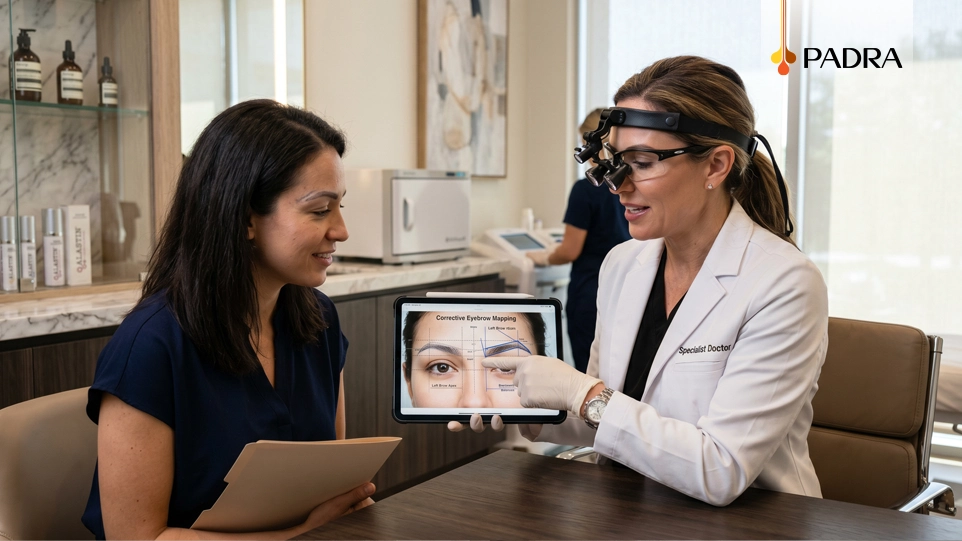
A great brow requires a serious artistic eye. Using a “one -size-fits- all” template or a generic stencil is a huge red flag. It completely ignores the unique shape of your bone structure, your eyes, and how your forehead actually curves.
Using Thick Donor Hair
A team that actually cares will spend the extra time harvesting only the finest, thinnest hairs from the very bottom of your hairline or behind your ears. The high-volume “hair factories” get lazy. They grab thick hair from the back of the scalp, leaving you with coarse, wiry brows.
Inexperienced Surgical Team
In a lot of those budget clinics, the actual surgeon just says hello and then leaves the room, letting unsupervised, under-trained technicians do the actual implanting. But mastering the shifting directions of a human brow takes years of experience, not a weekend crash course.
Overfilling the Eyebrow
More isn’t always better. Packing way too many grafts into a small area without considering natural spacing creates a dense, unnatural cluster of hair that looks completely synthetic.

Unnatural Eyebrow Transplant Results – The Biggest Red Flag
The human brain is weirdly good at noticing when something is even slightly “off” with a face. That’s why an unnatural eyebrow transplant stands out so fast. Even a single millimeter of misplaced hair is enough to make people do a double take.
Real brows don’t grow in neat, uniform military lines. They have these weird, beautiful, organic irregularities. There’s a specific “meeting point” or convergence line in the middle of your brow where the top hairs grow down, and the bottom hairs grow up. True precision is about copying that “natural chaos,” not chasing a stiff, plastic look. When a doctor fails to copy these ultra flat growth angles and irregular patterns, the results look completely fake.
Eyebrow Transplant Asymmetry – Why It Happens
Dealing with eyebrow transplant asymmetry can make you want to smash every mirror in the house. If one side looks completely different than the other, it usually comes down to a few specific oversights in the operating room:
- Flawed Pre-Design (Lying Down): Gravity does weird things to your skin when you’re flat on your back. If a clinic maps out your brows while you’re lying down instead of sitting up the symmetry completely warps the second you stand up and walk out the door.
- Lack of Symmetry Analysis: Inexperienced clinics don’t always bother measuring the exact distances from the bridge of your nose or the outer corners of your eyes before they start the procedure.
- Swelling During the Procedure: Local anesthesia makes your face swell up unevenly. A seasoned surgeon knows to trust their original pencil marks rather than trying to make “adjustments” on a swollen, distorted canvas mid-procedure.
- Incorrect Graft Placement: Using different graft sizes (like putting single hairs on one side and accidentally double hairs on the other) changes the perceived thickness and shape of the brows completely.
Eyebrow Transplant Failure — Can Grafts Not Grow?
One of the biggest fears people talk about is a total eyebrow transplant failure, just worrying that their body is going to reject the hair and leave them with nothing but scars.
The Reassuring Truth: True biological failure, where the grafts just die and refuse to grow, is actually incredibly rare.
Your face has a massive, crazy rich blood supply. It’s basically a perfect environment for hair to take root. If the hair genuinely doesn’t grow, it’s almost always because of mechanical errors or poor technique rather than your body rejecting them. Things like handling the follicles too roughly with forceps during extraction, letting them dry out on a tray for too long or bad aftercare like picking at scabs way too early can destroy the grafts.
Eyebrow Transplant Complications vs Bad Aesthetic Results
To save yourself some unnecessary panic, it helps to divide your worries into two totally different boxes because there is a massive difference between a medical issue and a bad design:
- Complications (Medical Issues): This means normal biological reactions like inflamed hair follicles (folliculitis), temporary little cysts, minor infections, or redness that stays a bit too long. These are easily fixed with standard medical care, simple creams, or antibiotics, and they rarely change how the final brow looks.
- Bad Aesthetic Results (Design/Technical Issues): This is all about poor growth angles, incorrect shapes, unnatural thickness, or crooked, asymmetrical lines. These are technique problems. They require corrective aesthetic work, not medical pills.
If you’re just stressing over normal healing signs, checking out our guide on standard hair transplant side effects can help you figure out if you’re just experiencing a regular recovery.
Can a Bad Eyebrow Transplant Be Fixed?
If you absolutely hate what you see in the mirror right now, please know you aren’t stuck like this forever. Fixing a botched transplant is totally possible with modern revision methods, though you have to set realistic expectations because correction may require time and patience.
- Correction Transplant: A real expert can tuck ultra-fine, single hairs at the correct, flat angles to blend out, reshape, and soften those harsh, blocky lines from the first surgery.
- Laser Removal: If hairs were placed way outside your natural brow line or pointed in completely wild directions, a few sessions of precise laser can wipe those rogue follicles out permanently.
- Reshaping via Micro-Extraction: Sometimes, the best bet is to carefully pluck the misplaced follicles out one by one using micro FUE tools and replant them the right way.
Just remember: revision work takes a lot of patience. You have to let the skin fully heal and wait for the old hairs to completely grow in before a doctor can safely fix the mess.
How to Avoid Eyebrow Transplant Gone Wrong
When it’s your face, prevention is everything. You can pretty much eliminate your risks of an eyebrow transplant gone wrong by being incredibly stubborn during your vetting process and tying everything back to prevention:
- Choose an Experienced Specialist: Skips the big hair factories and doesn’t go to a place that spends 99% of its time doing standard bald heads. It is better to find a facial hair specialist who lives and breathes brow restoration.
- Review Real Before/After Cases: When looking at eyebrow transplant before and after pictures, don’t just look at the overall shape from far away. Zoom right in. Look at the grain of the hair. Are they lying flat? Does the front look soft?
- Focus on Natural Direction, Not Density: Don’t fall for marketing hype promising “maximum density.” In the brow world, placement and ultra flat angles matter a million times more than the number of hairs jammed into your skin.
- Ensure Personalized Design: Make sure the surgeon designs a brow that matches your specific facial anatomy, not a template.
- Avoid “Cheap” Clinics: Your face isn’t something you want to buy on a discount. Cheap clinics stay open by rushing people through like cattle, and that’s exactly how these mistakes happen.
What a Natural Eyebrow Transplant Should Look Like
When a transplant is handled by an expert, it doesn’t look like a surgical procedure at all it looks like the brows you should have been born with. It provides a beautiful contrast to the harsh fake results we’ve talked about:
- Soft, Feathered Edges: The inner corners are light, airy, and irregular, blending seamlessly into your skin without any harsh, blocky boundaries.
- Correct Hair Direction: Every single hair lies flat against the bones, following the natural shifting patterns of real brows.
- Balanced Density: The thickness changes across the brow mimicking the natural flow from a softer bulb to a defined arch and tails.
- Face-Matching Design: The shape perfectly complements your unique bone structure and eyes.
An expert’s team will also take the time to evaluate alternative or complementary options. For instance, they will assess whether you are an ideal candidate by reviewing standard hair transplant candidate criteria or discuss how your brow position interacts with your upper face, sometimes noting how an eyebrow lift surgery contrasts or aligns with your aesthetic goals.
Final Thoughts — Most Bad Results Are Preventable
At the end of the day, an eyebrow transplant is a highly predictable, amazing procedure, but only if it is treated like a precision driven fine art instead of a mechanical assembly line job. Almost every single case where things go wrong traces back to technique related errors, cutting corners, lower prices, or untrained staff.
Choosing the right clinic is absolutely critical. Remember, natural design and correct hair angles matter a million times more than raw density. By taking your time and picking a team that treats your face like unique architecture, you can go into it with total peace of mind. You deserve brows that make you feel beautiful, not something you have to spend twenty minutes trying to hide every single morning.
If you want to read more about the biological safety side of things, check out our deep dive on eyebrow transplant risks. Or, if you’re ready to see what a properly planned, custom-mapped procedure actually looks like, head over to our eyebrow transplant service page or send us a message to book a personalized consultation with our specialists.