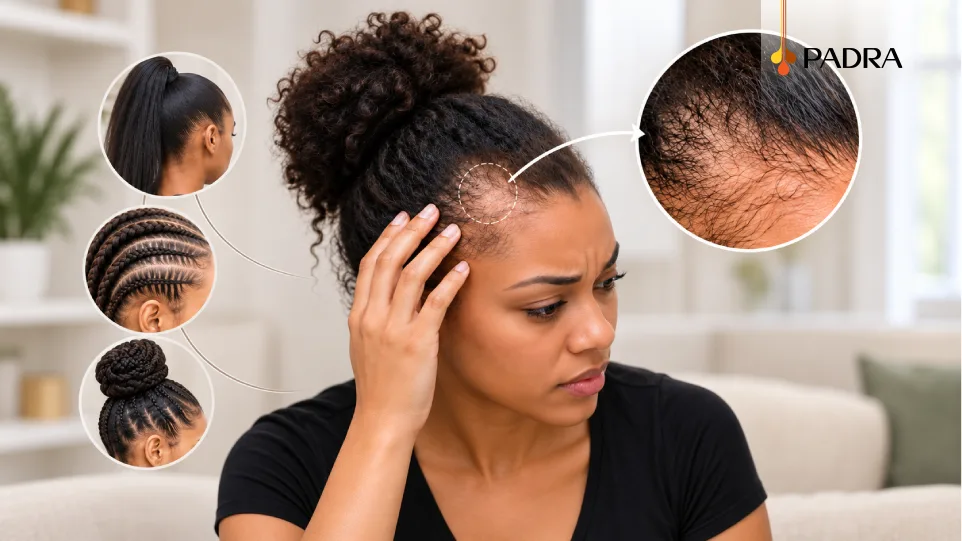
Traction alopecia is hair loss caused by repeated pulling on the hair follicles. It can improve when the pulling stops early enough, but prolonged tension may damage follicles permanently. The first step in treating it is to loosen or change the hairstyle responsible. Medicines may help in certain cases, particularly when inflammation is present, but they cannot bring back follicles that have been destroyed by scarring.
If you are noticing thinning edges, a widening hairline or short broken hairs around your temples, the most useful question is whether the follicles are still capable of growing hair. That determines what recovery may look like and whether additional treatment is worthwhile.
What Is Traction Alopecia and What Causes It?
Traction alopecia develops when hair is pulled repeatedly or held under tension for long periods. The strain often concentrates along the hairline, temples, behind the ears or wherever a style places the greatest pressure on the roots.
Common causes include:
- Tight ponytails, buns and slicked-back styles worn regularly.
- Braids, cornrows, twists or locs installed with excessive tension.
- Heavy extensions and weaves that pull on natural hair.
- Hair accessories or coverings that repeatedly rub or tug at the same area.
- Frequent styling that combines tight pulling with heat or chemical processing.
The problem is not a particular hairstyle or hair texture. It is the amount and duration of tension placed on the follicles. Traction alopecia can affect women, men and children. The American Academy of Dermatology (AAD) identifies repeated pulling as a preventable cause of hair loss.

What Are the Early Signs and Symptoms of Traction Alopecia?
Hairline thinning is often the first visible change. You may notice short or broken hairs along the edges, thinning at the temples, or patches in areas that are regularly pulled by a hairstyle.
Other signs can include scalp tenderness, itching, redness, small bumps around the follicles or a tight, sore feeling after styling. Some people have a fringe sign: a narrow line of remaining hairs at the front, with thinning just behind it.
These signs are useful clues, not a diagnosis. Pattern hair loss, alopecia areata and certain scarring conditions can produce similar-looking changes. A persistent or painful problem deserves a scalp examination.
Can Traction Alopecia Be Reversed? When Is It Too Late?
Early traction alopecia may be reversible if follicles are still intact. When repeated pulling continues for years, inflammation and injury can lead to scarring. Once a follicle has been replaced by scar tissue, it cannot produce hair again.
There is no reliable deadline, such as a set number of months, after which recovery suddenly becomes impossible. What matters is the condition of the follicles rather than how long someone has noticed thinning.
| What you notice | What it may indicate | Regrowth potential |
|---|---|---|
| Early thinning with short hairs still present | Follicles may still be functioning | Improvement may follow removal of tension |
| Thinning with persistent soreness or bumps | Ongoing injury or inflammation | Uncertain; assessment is important |
| Smooth, shiny skin with fewer visible follicular openings | Possible advanced scarring | Limited where follicles are permanently lost |
A smooth scalp can raise concern about scarring, but appearance alone cannot confirm it. A dermatologist may examine the area with trichoscopy and, where needed, recommend further tests. The earlier damaging tension ends, the better the chance of preserving remaining hair.
What Is the Best Treatment for Traction Alopecia?
Removing the source of pulling is the foundation of traction alopecia treatment. The remaining options depend on whether there is inflammation, whether follicles are still active and whether another type of hair loss is present.
| Treatment | When it may help | Important limitation |
|---|---|---|
| Looser, lower-tension styling | Every stage; prevents further strain | Cannot reverse established scarring |
| Gentle hair and scalp care | Reduces breakage and irritation | Not a proven follicle-regrowth treatment |
| Prescription corticosteroids | Selected cases with scalp inflammation | Requires medical assessment |
| Antibiotics | Diagnosed infection or selected inflammatory cases | Not routinely needed for traction alopecia |
| Minoxidil | May support growth where follicles survive | Evidence specific to traction alopecia is weak |
| Hair restoration procedures | Selected, stable areas of permanent loss | Requires specialist assessment and suitable donor hair |
When Are Steroid Treatments or Antibiotics Used?
If the scalp is visibly inflamed, a dermatologist may consider a topical corticosteroid or, in selected cases, corticosteroid injections. Antibiotics may be appropriate for a diagnosed infection or certain inflammatory presentations. These treatments should not be started just because a tight hairstyle has caused temporary itching.
Antifungal medicines are used when a fungal condition is diagnosed; they are not a standard treatment for traction alopecia itself. The priority remains stopping the repeated mechanical injury.
Can Minoxidil Help With Traction Alopecia Regrowth?
Minoxidil may be considered as an additional treatment when hair follicles are still viable, but it is not a substitute for changing a damaging hairstyle. Its effectiveness for traction alopecia is much less certain than its established role in pattern hair loss.
A systematic review of minoxidil for traction alopecia identified six eligible studies. Most were case reports or retrospective series, so the authors described the supporting evidence as very weak. Some patients improved, but the research does not justify promising regrowth.
Minoxidil cannot regenerate follicles lost to scarring. A clinician can assess whether it is suitable and help distinguish traction alopecia from another condition that might need different treatment.
Traction Alopecia Treatment at Home: What Can You Do?
The most effective home measure is to stop repeatedly pulling on vulnerable hair. Oils, shampoos and supplements cannot compensate for a hairstyle that keeps damaging the follicles.
- Release the tension. Loosen or remove styles that cause pain, stinging, bumps or tightness.
- Change how you style your hair. Choose loose styles and avoid pulling the same hairline sections every day.
- Reduce extension weight. Shorter, lighter attachments place less strain on fragile edges.
- Handle hair gently. Detangle without force and limit unnecessary brushing or manipulation.
- Limit further irritation. Reduce excessive heat and potentially harsh chemical treatments around affected areas.
- Track the changes. Take occasional photographs in similar lighting and from the same angle.
Gentle shampoo and conditioner can make hair easier to manage, but they do not treat scarred follicles. If thinning continues after changing styles, or if your scalp remains painful or inflamed, seek medical advice rather than trying progressively stronger home remedies.
How Is Traction Alopecia Treated in Women?
For women, the first step is to identify where tension is coming from. Tight buns, ponytails, braids and extensions may affect the temples or frontal hairline, particularly when the same areas are pulled every day.
Women with traction alopecia may also have another cause of thinning, such as female pattern hair loss or a scarring condition. This matters because different diagnoses require different treatment. A clinician can assess the scalp before recommending medication or a procedure.
Changing the styling routine early offers the best chance to protect remaining follicles. When loss has become permanent, a specialist may discuss restorative options, but that decision should come after the condition is stable.
How Is Traction Alopecia Treated in Children?
Children can develop traction alopecia from tight braids, ponytails, buns and other styles that pull repeatedly at the hairline. Treatment begins with parents or caregivers removing the source of tension and choosing styles that do not hurt or strain the roots.
Avoid tight braiding around the edges, heavy attachments and the expectation that a hairstyle must feel tight to last. Tell the stylist if a child experiences pain, bumps or soreness, and change the style rather than asking the child to tolerate it.
Hair loss in children has several possible causes, including fungal infections and alopecia areata. If there are bald patches, scaling, inflammation or persistent thinning, a pediatrician or dermatologist should check the diagnosis. Do not start minoxidil or prescription scalp treatments for a child without medical guidance.
For more detail, see the clinical review of traction alopecia in children.
Traction Alopecia Treatment for Black Hair and Textured Hair
Traction alopecia can affect any hair type. For people who wear braids, cornrows, locs, twists or weaves, prevention is especially practical: keep the style comfortable, avoid excessive weight and protect the edges from repeated pulling.
- Ask for looser braids or cornrows, especially around the hairline.
- Choose lighter or shorter extensions when possible.
- Remove styles that cause pain, tenderness or small bumps.
- Give the hairline breaks from sustained tension and vary where the hair is pulled.
- Be careful when combining tight styles with chemical relaxers or high heat.
These are adjustments to tension, not judgments about a cultural hairstyle. Textured hair can also be affected by other conditions, including central centrifugal cicatricial alopecia (CCCA). Thinning at the crown, ongoing inflammation or an unusual pattern should not automatically be assumed to be traction alopecia.
Can You Stop Traction Alopecia Naturally?
You can reduce the cause of traction alopecia without medication by changing the practices that pull on your hair. That is different from treating the condition with oils, masks or supplements.
No natural oil, shampoo or supplement has been established as a reliable way to reverse traction alopecia. Oils or conditioners may make hair easier to handle and reduce breakage, but they cannot restore destroyed follicles. Biotin supplements should not be presented as a treatment unless a relevant deficiency has been identified.
If you want to start without medication, focus on lower-tension styles and gentle care. Seek professional assessment if the hairline continues to recede or the scalp is inflamed.
How Long Does Traction Alopecia Take to Grow Back?
Some people with early traction alopecia notice new growth over several months after stopping the tension. Others see only partial improvement. There is no fixed timeline that applies to every person.
The outcome depends on how long the area was pulled, whether the follicles survived, the degree of inflammation and whether another hair-loss condition is present. Short hairs appearing along the edges may be encouraging, but they do not guarantee a return to the original density.
If the hairline keeps thinning despite changing your hairstyle, or there is little improvement and the diagnosis remains uncertain, arrange a professional review instead of waiting indefinitely.
How Can You Prevent Traction Alopecia?
The simplest prevention rule is that a hairstyle should not hurt. Avoid wearing hair under constant tension, particularly at the same points along the edges. Loosen tight braids, alternate styles and avoid leaving heavy extensions in place when they cause discomfort.
Pay attention to early warning signs: soreness after styling, bumps, broken hairs and a gradually thinner hairline. Acting before obvious bald patches appear gives the follicles the best chance of staying healthy. The AAD offers practical guidance on avoiding hair loss from tight hairstyles.
When Should You See a Dermatologist?
Book an assessment if hair loss is progressing, if the scalp is sore or inflamed, or if you cannot tell whether traction is the cause. Smooth bald patches, loss at the crown, widespread shedding and areas that do not improve after changing hairstyles also deserve attention.
A dermatologist may assess your styling history, examine the scalp using magnification and check for other conditions. That evaluation helps determine which hair loss treatment options may be appropriate.
Can a Hair Transplant Treat Permanent Traction Alopecia?
Hair transplantation may be an option for selected people whose traction alopecia has caused stable, permanent hair loss. It is not the first step when tight styling continues, scalp inflammation is active or the diagnosis is uncertain.
Suitability depends on the condition of the recipient scalp, the availability of donor hair and realistic expectations about coverage. Our separate guide to hair transplant for traction alopecia explains these surgical considerations in more detail. Women evaluating surgical restoration can also review women’s hair transplant options.
Whether surgery is appropriate or not, preventing further pulling remains essential.
If your hairline is thinning, start by removing the source of tension. If you see inflammation, continued loss or possible scarring, seek a diagnosis before trying additional treatments. Early action may protect follicles that are still functioning.