







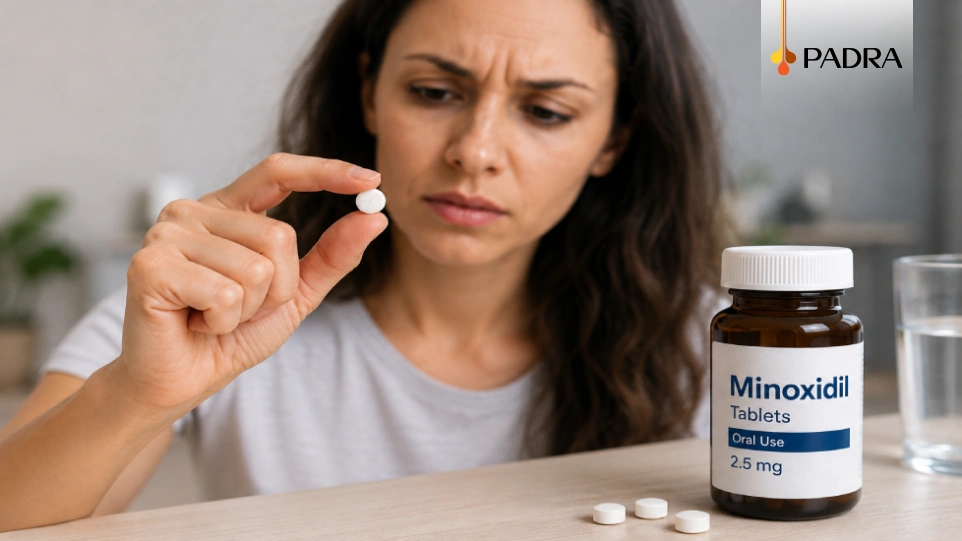
Oral minoxidil tablets are approved for severe or treatment-resistant hypertension, while their use for hair loss is generally off-label. Low-dose oral minoxidil may be prescribed by clinicians for selected patients, but it can cause systemic side effects because the medication reaches the whole body.
Oral minoxidil is different from topical minoxidil, which is applied directly to the scalp. Terms such as “Rogaine pills” or “oral Rogaine” are not official names for an approved hair-loss tablet. Dose selection requires medical assessment and should not be based on online recommendations.
Oral minoxidil can cause unwanted body-hair growth, dizziness, fluid retention, swelling and a faster heart rate. Rare but serious cardiovascular problems are described in the oral drug label. Because hair-loss use is off-label, treatment should be supervised by a clinician—especially in people with heart, kidney or blood-pressure conditions.
Oral Minoxidil Side Effects: Common, Dose-Related and Serious Risks
Side effects should be interpreted according to their severity and the type of evidence supporting them.

Common or more frequently reported
- Hypertrichosis or unwanted facial and body hair
- Lightheadedness
- Ankle swelling
- Fluid retention
- Puffiness around the eyes
- Headache
Cardiovascular effects requiring medical review
- Palpitations
- Faster heart rate
- Symptomatic low blood pressure
- Persistent swelling
- Rapid or unexplained weight gain
Urgent warning signs
- Chest pain
- Fainting
- Shortness of breath
- Rapid or irregular heartbeat
- Severe or increasing swelling
- Symptoms suggesting fluid around the heart
A retrospective multicentre study followed 1,404 patients receiving low-dose oral minoxidil for different forms of hair loss. Its findings are useful for understanding commonly reported effects, but they are not universal incidence rates because the study had no control group and treatment doses varied.
| Side effect | Reported rate | Warning signs | Suggested response |
|---|---|---|---|
| Hypertrichosis | 15.1% | Significant unwanted facial or body hair | Discuss tolerability with the prescriber |
| Lightheadedness | 1.7% | Fainting, weakness or persistent symptoms | Contact the prescribing clinician |
| Fluid retention | 1.3% | Marked swelling, breathing difficulty or rapid weight gain | Prompt medical assessment |
| Tachycardia | 0.9% | Rapid or irregular heartbeat or chest pain | Seek medical advice promptly |
| Headache | 0.4% | Severe or persistent pain or neurological symptoms | Medical review if concerning |
| Periorbital edema | 0.3% | Increasing facial swelling or breathing problems | Contact the clinician |
| Pericardial effusion | LDOM frequency not established | Chest discomfort, breathlessness or fainting | Urgent medical evaluation |

No life-threatening adverse effects were observed in that cohort, but its retrospective design cannot prove that serious reactions are impossible.
Is Oral Minoxidil Approved for Hair Loss?
No. Minoxidil tablets are approved as a prescription treatment for significant hypertension that has not responded adequately to other medications. Hair-loss prescribing is an off-label clinical use. For a broader overview of effectiveness, expected results and treatment timelines, see our guide to oral minoxidil for hair loss.
The label contains a boxed warning concerning fluid retention, increased cardiac workload, worsening angina and pericardial effusion in systemic antihypertensive use. These warnings matter, but their reported rates should not be presented as the incidence among low-dose hair-loss patients.
What Are the Most Common Low-Dose Oral Minoxidil Side Effects?
Hypertrichosis is consistently the most frequently reported effect. Because the tablet circulates throughout the body, follicles outside the scalp may also be stimulated.
A pooled analysis of 442 patients found hypertrichosis in 24% and lower-limb edema in 2%. Higher doses were associated with increased odds of both effects. Postural symptoms and heart-rate changes were less frequent, but still possible.
A separate meta-regression also found that increasing dose was associated with higher rates of hypertrichosis and cardiovascular adverse events. This supports individualized prescribing rather than treating one dose as appropriate for everyone.
Can Oral Minoxidil Affect the Heart?
Yes. Oral minoxidil is a systemic vasodilator, so it can affect heart rate, fluid balance and cardiovascular workload.
- Palpitations
- Tachycardia
- Fluid retention
- Worsening angina
- Edema
- Pericardial effusion
The official antihypertensive label reports pericardial effusion in about 3% of treated nondialysis patients, particularly when kidney function was compromised. That percentage comes from systemic treatment of severe hypertension and must not be applied directly to low-dose hair-loss treatment.
Kidney impairment can increase concern because the body may have more difficulty managing fluid balance and clearing the medication and its metabolites.
Can Oral Minoxidil Cause Low Blood Pressure?
Dizziness and lightheadedness may occur, especially in people with low baseline blood pressure, a history of fainting or concurrent blood-pressure medication.
Symptoms that appear when standing may reflect a meaningful blood-pressure response, but the cause cannot be diagnosed from an article. Persistent dizziness, weakness or fainting requires medical assessment.
Users should not independently change prescribed medication, increase salt intake or alter their oral minoxidil dose to manage symptoms.
Does Oral Minoxidil Cause Body-Hair Growth?
Yes. Hypertrichosis is one of the most frequently reported oral minoxidil side effects. Hair growth may become more noticeable on the face, arms, legs, back, chest or other body areas.
This is hypertrichosis, not hormonal virilization. It does not mean the medication has changed androgen levels, and it does not guarantee that scalp density will improve.
The official systemic label notes that unwanted hair growth may take one to six months to move back toward its pretreatment appearance after discontinuation. Individual timelines can differ.
Side Effects at 1 mg, 1.25 mg, 2.5 mg and 5 mg
These numbers reflect common search queries and study doses—not recommendations.
| Dose searched | Responsible interpretation |
|---|---|
| 1 mg | Often described as low-dose use, but systemic effects remain possible |
| 1.25 mg | May still cause hypertrichosis, dizziness, edema or palpitations |
| 2.5 mg | Cardiovascular or fluid-retention effects may become more relevant in susceptible users |
| 5 mg | Studied in some male hair-loss trials, but not a universal dose |
No dose is suitable for everyone. Selection depends on diagnosis, sex, blood pressure, cardiovascular and kidney history, concurrent medication and treatment tolerance.
A randomized trial in men compared 5 mg oral minoxidil with 5% topical minoxidil for 24 weeks. Hypertrichosis and headache were among the more common oral-treatment effects, and the oral route was not shown to be generally superior to topical treatment.
Users should not split, start, increase or reduce tablets based on dose tables in an online article.

Oral Minoxidil Side Effects in Women
- Facial or body hypertrichosis
- Ankle or facial swelling
- Dizziness
- Headache
- Palpitations
- Changes in blood pressure
Unwanted facial hair may be particularly difficult for some women to tolerate. Hair loss in women may also involve postpartum changes, thyroid disease, PCOS, nutritional deficiency or female pattern hair loss. Oral treatment should not be presented as appropriate for every form of female shedding.
For diagnosis-led information, review female pattern hair loss. The current oral label states that adequate controlled studies in pregnancy are lacking and advises against administration during breastfeeding because of potential infant exposure.
Oral Minoxidil Side Effects in Men
Men may experience hypertrichosis, headache, fluid retention, edema, palpitations or blood-pressure symptoms.
Cardiovascular history remains relevant even when the treatment is prescribed for male pattern baldness rather than hypertension.
Oral minoxidil is not an anti-androgen. It therefore does not share the same typical mechanism or side-effect profile as finasteride, although both medications may sometimes appear within the same treatment plan.
Who Needs Extra Caution?
- Cardiovascular disease
- Angina or previous heart symptoms
- Previous pericardial disease
- Kidney impairment
- Fluid-retention problems
- Low blood pressure
- A fainting history
- Pregnancy or breastfeeding
- Multiple blood-pressure medications
- Sudden, patchy or unexplained hair loss
The international expert consensus on low-dose oral minoxidil covers contraindications, precautions, baseline evaluation and monitoring. It also acknowledges that stronger comparative and long-term data are still needed.
What Are the Long-Term Side Effects?
Long-term evidence for low-dose oral minoxidil in hair-loss patients remains more limited than the evidence for topical minoxidil.
Observational studies provide useful reassurance about short- and medium-term tolerability in selected patients, but they cannot establish complete long-term safety across every dose, diagnosis and risk group.
Long-term monitoring may depend on blood pressure, cardiovascular history, kidney function, symptoms, concurrent medication and the prescribed dose. The expert consensus specifically identifies long-term safety as an area requiring further research.
What Happens After Stopping Oral Minoxidil?
Hair effects
Hair maintained or supported by treatment may gradually shed after discontinuation. The underlying condition may then resume its previous course.
Side effects
Dizziness, swelling or palpitations may improve when exposure ends, but symptoms should still be managed by the prescribing clinician. Unwanted facial or body hair may take several months to reduce.
Stopping suddenly or tapering should not be recommended universally. Changes to a prescription should be discussed with the clinician responsible for treatment.
Oral vs Topical Minoxidil: Which Has More Side Effects?
| Factor | Oral minoxidil | Topical minoxidil |
|---|---|---|
| Exposure | Systemic | Primarily local |
| Common concern | Hypertrichosis and systemic symptoms | Scalp irritation and residue |
| Blood-pressure effects | More relevant | Less likely, but possible |
| Edema and palpitations | Greater concern | Uncommon with correct use |
| Availability | Prescription | Often OTC, depending on market |
| Medical supervision | Required | Label-led use with medical review when needed |
The oral route produces greater systemic exposure. Topical minoxidil more commonly causes itching, dryness, redness or contact irritation.
The 24-week randomized trial in men did not establish oral minoxidil as generally superior to 5% topical treatment. Treatment choice should therefore consider safety, tolerability and medical suitability rather than assuming the tablet is stronger or better.
Concerned About Minoxidil Side Effects?
If you are unsure whether oral or topical treatment is more appropriate for your health and hair-loss pattern, our consultants can explain the practical differences and guide you toward an appropriate professional assessment.
Are Reddit Reviews Reliable Evidence?
Reddit and patient reviews may reveal concerns people commonly discuss, such as unwanted facial hair, dizziness, swelling or difficulty maintaining treatment.
- How frequently a side effect occurs
- Whether minoxidil caused the symptom
- Which dose is safe
- Whether another person should stop treatment
- Long-term cardiovascular safety
Online experiences lack standardized diagnosis, dosing, monitoring and control groups. They should be treated as personal reports rather than clinical evidence.
How Should Before-and-After Results Be Judged?
Photographs should use the same lighting, camera angle, hairstyle, hair length and scalp position. Treatment duration and other medications should also be disclosed.
Body-hair growth is not proof of scalp success, and attractive before-and-after photographs do not make side effects irrelevant. Effectiveness and safety should always be evaluated separately.
When Oral Minoxidil May Not Be the Right Option
- Systemic side effects are unacceptable
- Cardiovascular risk is significant
- Topical treatment is tolerated
- The hair-loss diagnosis is uncertain
- Another medical condition is causing shedding
- Follicles are no longer active
Depending on the diagnosis, hair-loss treatment options may include topical medication, PRP, mesotherapy or other medical approaches.
When follicles in the target area are no longer active and donor hair is suitable, an evaluation of hair transplant options may be more relevant than continued medication changes.
Is Oral Minoxidil Safe for Hair Loss?
Low-dose oral minoxidil may be tolerated by selected hair-loss patients, but it remains an off-label systemic prescription treatment rather than a risk-free hair-growth pill.
Unwanted facial or body hair is the most commonly reported effect. Dizziness, edema, fluid retention, headache and a faster heart rate can also occur.
Heart disease, kidney impairment, low blood pressure, pregnancy, breastfeeding and concurrent medication require particular attention. Chest pain, fainting, breathing difficulty, irregular heartbeat, severe swelling or sudden weight gain require prompt medical assessment.