




Hair transplant density is shaped by graft placement, donor strength, hair thickness, curl, and surgical planning—not just numbers. Early results often look thin due to shedding and fine regrowth, but real fullness develops gradually as hairs mature. Noticeable density typically improves between 6 and 9 months, with peak results typically occurring around 12 to 18 months. Ultra-high density isn’t always ideal; balanced, natural distribution typically delivers better coverage, healthier graft survival, and longer-lasting results.
Density stands out as a major concern for many who are searching for a hair transplant. You spot it in every ad and discussion, with bold claims about restoring that full, thick head of hair. But let's get honest about hair transplant density—what it entails, how surgeons achieve it, and the kind of results you can actually count on. I'll break it all down here, tackling common myths and setting straight expectations. If you're considering a procedure or worried about your current progress, this should provide a clearer picture and offer you a bit more peace of mind.
Getting Clear on What Hair Transplant Density Actually Involves
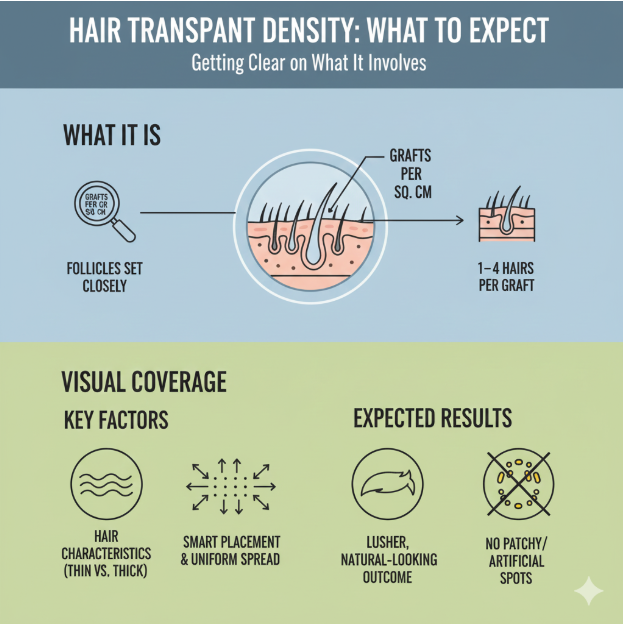
Hair transplant density comes down to how closely those new follicles are set in the balding or thinning zones, influencing how lush and lifelike the outcome feels. Medically, it's measured by grafts per square centimeter—small bundles, each with one to four hairs, harvested from a donor site like the rear of your scalp and relocated to fill in gaps.
Yet, numbers alone don't tell the whole story. Visual coverage relies on hair qualities and smart placement. Someone with thinner strands might need more grafts for the same effect as thicker ones provide naturally. The focus remains on a uniform spread that integrates smoothly with your existing hair, dodging any patchy or artificial spots.
Unsure if high density suits you?
A specialist can clarify for your case
Should You Go for a High-Density Hair Transplant? Let's Look at Both Sides
High-density hair transplant pitches are everywhere, promising 50 or more grafts per square centimeter for that quick, voluminous boost. When it matches your needs, it can really enhance coverage in prominent areas.
That said, pushing for ultra-high density carries risks. Overpacking can disrupt blood flow, leading to slower recovery or graft failure. It might even look off if not executed perfectly. Your donor supply isn't unlimited, so overdoing it could limit options down the road. From what I've seen with patients, opting for a balanced density often leads to more satisfying, natural results that align with your features.
The Main Things That Decide How Dense Your Hair Transplant Will End Up
Your final hair transplant density hinges on several key elements. The donor area's strength is crucial—if it's healthy and abundant, it supports better overall fill.
Hair traits make a difference, too, such as strand thickness and curliness. Coarser, curlier hair can create a denser illusion with fewer grafts. Skin-to-hair color contrast plays in; bigger differences may require more to avoid scalp visibility.
Surgical methods seal it. Techniques like FUE or FUT let surgeons position grafts for optimal growth. In 2025, innovations like Sapphire FUE for precise incisions and AI-assisted planning refine this, adapting to your specifics for seamless integration.
The Step-by-Step Build-Up to a Truly Thick Hair Transplant
Hoping for a thick hair transplant? It's a gradual reveal, not instant gratification. After surgery, transplanted hairs often shed—shock loss, it's normal. Regrowth starts around three to four months, but those early ones tend to be fine and sparse.
As months pass, follicles strengthen, producing thicker shafts. Noticeable thickening often hits by six to nine months, with peak density emerging at 12 to 18 months. This timeline reflects natural adaptation. If initial views underwhelm, stay patient—it's gearing up for the real deal.
Curious about your path?
A consultant can guide you personally
How Transplanted Hair Density Stacks Up Against What You Had Naturally
Wondering why transplants don't always replicate your original density exactly? Healthy scalps average 80 to 100 follicular units per square centimeter, but procedures work within donor limits, so matches aren't precise.
The clever part is strategic layering—denser at the front for definition. This yields convincing fullness even below peak numbers. In daily settings, with normal light and styling, it all flows together, favoring realism over exact counts.
Why Your New Hair Might Not Look as Dense as You'd Hoped Initially
It's typical to check your mirror and wonder about the density. Usually, it's the stage—starter hairs are slimmer, with maturation ahead.
Lighting tricks the eye; overhead glare exposes more, while diffuse shows potential. A good style can enhance it. Online pics? Often idealized, not raw reality. Ground expectations in your baseline, and things generally improve.
Can You Count on Density Picking Up After 6 to 12 Months?
Yes, this phase often brings encouraging shifts. Beyond six months, hairs mature, gaining substance. Many see 20-30% more perceived density as everything settles.
Healthy habits like nutrition and low stress aid this. If past a year with concerns, a check-in provides clarity.
How Experts at Clinics Design for Authentic Density
Quality clinics deliberately map density. They assess donors, then distribute: a tighter hairline for sharpness, a broader crown for span.
The mid-scalp gets even focus to prevent strain. Medical supervision keeps it safe, yielding enduring, genuine results.
Hair transplant density isn't just metrics—it's about natural coverage that rebuilds confidence. High-density hair transplant appeals for speed, but realistic alignment delivers the best thick hair transplant. Trust the process, ignore exaggerated comps, and embrace steady gains.
Tips to Boost and Maintain Hair Transplant Density
After a hair transplant, simple daily habits can help your new hair reach its full potential. It’s less about gadgets or extra procedures and more about supportive routines.
- Eat nutrient-rich foods: Focus on biotin, zinc, and protein (eggs, nuts, lean meats).
- Protect from sun: Use hats or scalp-friendly sunscreen to prevent UV damage.
- Handle gently: Avoid tight hairstyles and harsh brushing.
- Optional boost: Low-level laser therapy caps can support growth—consult your doctor first.