








Hair transplant for women is a personalized solution that depends on the cause, pattern, and stability of hair loss:
- Suitable for women with stable loss and adequate donor density
- Common techniques include FUE and FUT, designed for soft, feminine hairlines
- Effective for hairline recession, traction alopecia, and some cases of female pattern thinning
Recovery is gradual, with visible growth from 3–4 months and final results up to 12–18 months
Realistic expectations and expert planning are essential for natural-looking outcomes.
If you’re asking “can women get hair transplants?” — short answer: yes, many women can. This guide, A Guide to Hair Transplant for Women, walks through what matters: why women’s hair restoration differs from men’s, who makes a good candidate, the types of female hair transplant surgery, what to expect during recovery, and how to choose the right clinic. I’ll use clear, simple words and practical advice so you can make an informed choice.
Can women get hair transplants? (Do women get hair transplants?)
Yes — women can have hair transplants, but the path is often different than for men. Questions women commonly search: can women get hair plugs? Can women get hair transplants? Can women have hair transplants? Do women get hair transplants? — the answers depend on the cause and pattern of hair loss.
Why it differs:
- Women more often have diffuse thinning or female pattern hair loss, which can make surgery less straightforward than treating a clear bald spot in men.
- Female hairline design needs a softer, more natural shape to avoid a masculine look.
- Donor area quality (how much hair you have behind and on the sides of your head) is a key factor.
Understanding hair loss in women
Before any treatment, getting a clear diagnosis matters. Common female hair problems:
Female pattern baldness (androgenetic alopecia)
- Thinning across the top and crown, often with the frontal hairline intact early on.
Diffuse thinning
- Hair gets thinner everywhere. This can reduce donor supply and change suitability for transplant.
Traction alopecia
- Caused by tight hairstyles (braids, ponytails, extensions). It often affects the hairline and temples.
Hairline recession in women
- Some women lose hair along the forehead border. Fixing this needs careful hairline design.
A correct diagnosis (often by a dermatologist or hair restoration surgeon) stops wasted time and sets realistic expectations.
Hair Transplant for Women — Who Is a Good Candidate?
A hair transplant for women is best suited for those with stable hair loss, adequate donor area quality, and realistic expectations about improvement rather than complete fullness. Women with localized thinning or hairline recession often respond well, while surgery may not be recommended for those with widespread, active diffuse thinning or untreated medical causes such as hormonal or nutritional issues.
In some situations, non-surgical treatments may be advised first to support overall hair health before considering hair transplant surgery for women.
Types of Hair Transplant Surgery for Women
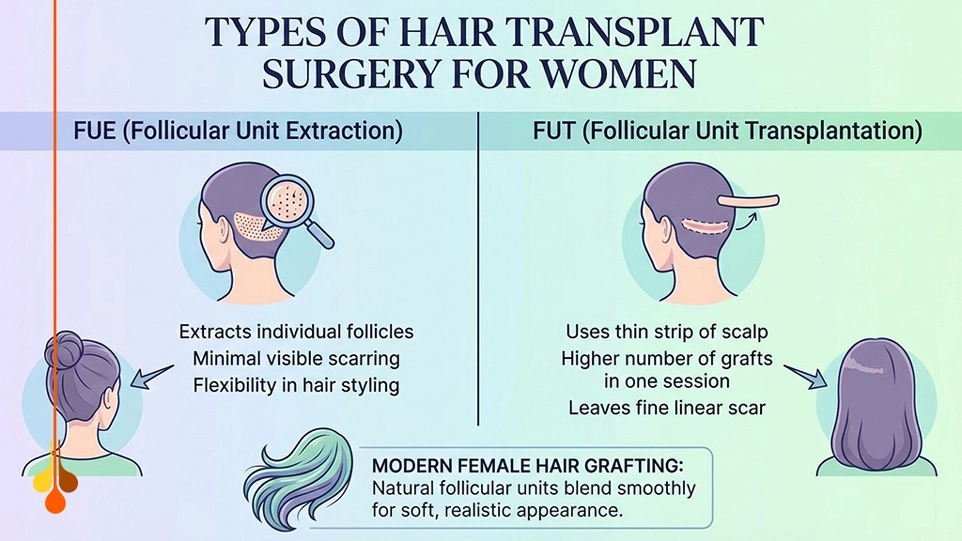
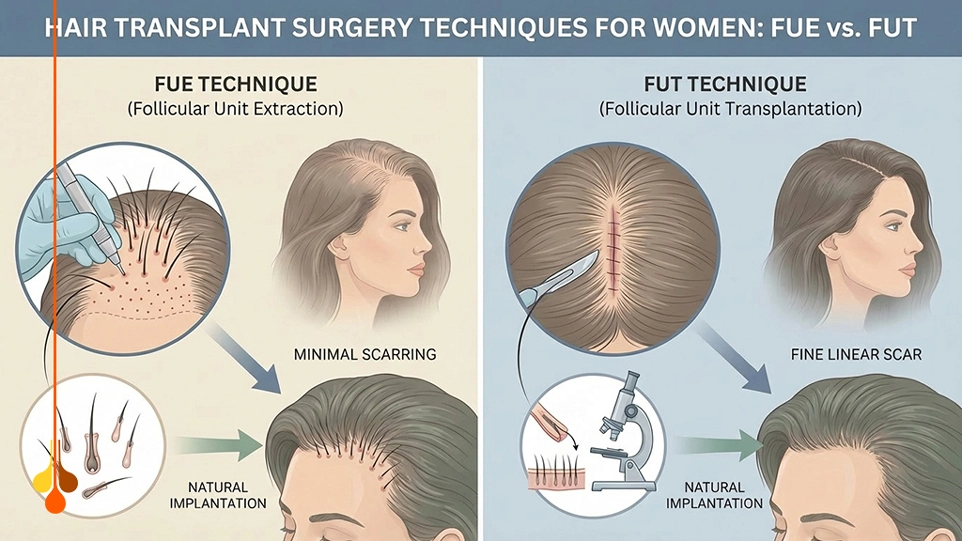
Modern hair transplant surgery for women mainly uses FUE or FUT techniques, both designed to produce natural-looking results. FUE involves extracting individual follicles with minimal visible scarring and offers flexibility in hair styling, while FUT uses a thin strip of scalp to obtain a higher number of grafts in one session, leaving a fine linear scar. Unlike older female hair plugs, today’s female hair grafting relies on natural follicular units, allowing female hair implants to blend smoothly with existing hair and achieve a soft, realistic appearance.
Female hairline transplant and hairline restoration
Designing a woman’s hairline is an art and a science:
- A natural female hairline is typically softer, rounded, and irregular (not a straight line).
- Avoid a too-low or blocky hairline that reads as masculine.
- Surgeons should consider age, face shape, and future hair loss.
Hair Transplant for Female Pattern Baldness
Hair transplant for female pattern baldness can be more complex because thinning often occurs across larger areas of the scalp, which reduces the available donor reserve. For this reason, better outcomes are often achieved with a combined approach that includes medical therapy alongside hair grafting for women.
The main goal is usually to improve visible density rather than achieve full restoration, and surgeons must carefully balance coverage with long-term donor preservation when planning a female hair implant.
Hair Transplant for Different Hair Types (Including Black Female Hair Transplant)
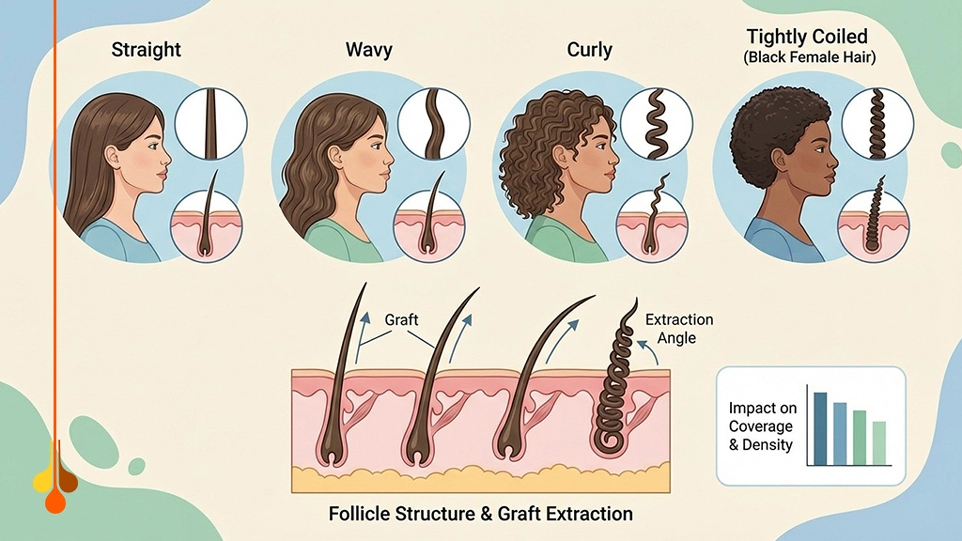
Hair type plays a significant role in how a hair transplant for women is planned and performed. Curly or tightly coiled hair, which is common in Black female hair transplant cases, requires experienced surgical teams because the curved structure of the follicles can increase graft fragility.
Texture and density also influence how much coverage can be achieved, as thicker hair shafts often provide better visual fullness, making it essential to choose a clinic with proven experience working with your specific hair type.
Hair restoration for women — surgical vs non-surgical options
Surgical:
- FUE / FUT / hairline transplant women.
Non-surgical:
- Medical therapy (topical minoxidil, oral medications when safe).
- Platelet-rich plasma (PRP) and low-level laser therapy.
- Hair systems or female hair replacement surgery (non-surgical hairpieces and prosthetics) for immediate coverage.
Often the best plan mixes options — surgery plus medical therapy helps preserve what you have and prolong results.
What does the hair transplant process look like for women?
Consultation and planning
- Detailed scalp exam, review of medical history, photo documentation, and discussion of goals. Expect to talk about donor area quality and long-term plan.
Procedure day (brief)
- Local anesthesia is common. FUE hair replacement can take several hours; FUT may be shorter for large graft numbers. You’ll go home the same day in most cases.
Healing vs growth timeline
- First 2 weeks: scabs and crusting heal.
- 2–4 weeks: “shock loss” of transplanted and native hairs can happen (normal).
- 3–4 months: early regrowth.
- 9–12 months: majority of final results appear; 12–18 months for full maturation.
Recovery, Aftercare, and Emotional Adjustment for Women
Recovery and aftercare for women following a hair transplant usually involve mild and temporary effects such as swelling, tenderness, and scabbing in the treated areas. Patients receive clear instructions on washing, sleeping positions, and activity limits to support proper healing.
Managing visibility during early recovery is a common concern, and light options such as hats, scarves, or gentle styling may be used once approved, while heavy makeup or styling products should be avoided until the scalp has healed.
Beyond physical recovery, the emotional stages of womens hair restoration are important to acknowledge, as it is normal to feel hopeful, impatient, or uncertain during the waiting period before growth begins. Understanding these stages and having proper guidance helps make the recovery experience more manageable.
Results, Long-Term Expectations, and Risks
Hair transplant results for women develop gradually, with visible regrowth typically beginning around three to four months and more noticeable improvement appearing between six and nine months, while final outcomes may take a year or longer.
Results vary based on individual hair characteristics, surgeon experience, and ongoing hair loss, which is why long-term expectations should be discussed early. Womens hair restoration is a continuing process, and future treatments or medical therapy may be needed to maintain density as hair naturally ages.
Common side effects include temporary scabbing, mild discomfort, numbness, or swelling, while complications such as infection or poor graft survival are less common when surgery is properly planned. Ethical clinics avoid guarantees and instead focus on educating patients about realistic outcomes, risks, and the long-term nature of hair restoration.
Ready for a Personalized Plan?