








Hair transplant scars are unavoidable but rarely obvious with modern techniques.
- FUE leaves tiny dot-like marks that are difficult to detect, even with short hair
- FUT creates a fine linear scar that is usually hidden under longer styles
- Scar visibility depends on skin type, the surgeon’s skill, and aftercare
- Existing scars can often be improved with SMP, laser therapy, revision surgery, or grafting into the scar
With proper planning, hair restoration can be achieved without noticeable marks.
When you start thinking about restoring your hair, excitement often comes mixed with a little bit of worry. The biggest concern we hear isn’t usually about the hair growth itself—it’s about what happens to the skin. Specifically, patients worry about the hair transplant scar.
It is completely normal to be anxious about scarring. Nobody wants to trade hair loss for a visible mark on the back of their head.
The good news is that modern technology has changed the game. While surgical procedures generally leave some trace, the goal of today’s skilled surgeons is to make those traces virtually invisible to the naked eye. This guide will guide what you can realistically expect, the differences between techniques, and how to handle any scarring that does occur.
Hair Transplant Scar: Does Modern Surgery Always Leave a Mark?
Let’s talk about this question: Does a hair transplant leave scars? The short answer is yes.
Whenever the skin is cut or punctured during a medical procedure, the body heals by forming tissue that differs from normal skin.
However, there is a massive difference between a visible, unsightly scar and the microscopic changes left behind by modern surgery.
In the past, older methods resulted in obvious marks. Today, a hair surgery scar is often so small or well-concealed that even your barber might not notice it unless they are looking for it. The visibility depends heavily on the technique used, your skin type, and how well you follow aftercare instructions.
Consider that all surgeries leave a mark, but with the right surgeon and technique, these marks should be minimal and easily covered by your hair.
Understanding Hair Transplant Scars: FUE vs. FUT Types and Visibility
Not all scars are created equal. The type of mark you might have depends entirely on the method used to extract the hair follicles.
The Hair Transplant FUT Scar
Follicular Unit Transplantation (FUT), also known as the “strip method,” involves removing a thin strip of skin from the back of the scalp. This allows the surgeon to get a high number of grafts at once.
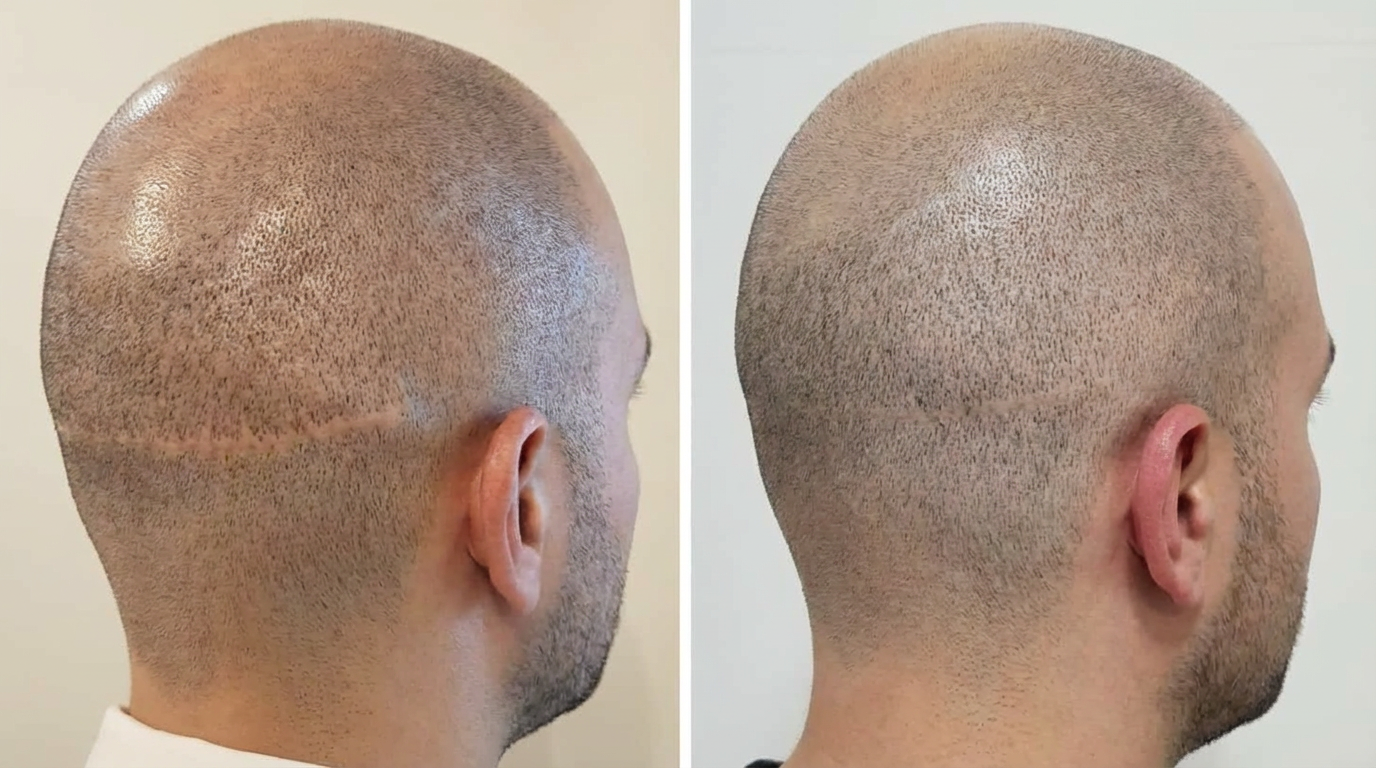
The result is a linear scar. Immediately after surgery, this line is red and tender. However, a FUT scar after 1 year typically fades to a very fine, pale line. Because this line is usually located in the middle of the donor zone, it is easily hidden by surrounding hair, provided you don’t shave your head down to the skin.
Follicular Unit Extraction Scarring
FUE (Follicular Unit Extraction) is the modern standard for many patients. Instead of a strip, the surgeon removes follicles one by one.
FUE scarring looks very different from FUT. It appears as tiny, dot-like white marks scattered across the back of the head. Because there is no long incision, there is no linear scar. These tiny dots are generally much harder to see, allowing patients to wear their hair shorter than they could with a FUT procedure.
Old-School Hair Plug Scars
You may have seen older men with what looks like “doll hair.” These are hair plug scars from outdated techniques used decades ago. These plugs were large chunks of tissue, leading to a “cobblestone” skin texture or very obvious, round, white scars. Modern hair graft scar patterns are infinitely more refined than these old plugs.
FUE vs. FUT Scarring: The Key Difference That Impacts Hair Length
Choosing between FUE and FUT often comes down to how you plan to wear your hair.
- The FUT Trade-off: You get a higher yield of hair in a single session, but you are left with a linear hair transplant fut scar. If you like keeping your hair a bit longer (a #3 guard or higher), this scar will likely remain completely hidden.
- The FUE Advantage: If you prefer very short fades or buzz cuts, FUE is usually the better choice. The tiny dots from follicular unit extraction scarring blend in with the scalp much better than a straight line.
Neither is “bad,” but one will likely fit your lifestyle better than the other.
Can We Fix or Reduce a Hair Transplant Scar?
What if you already have a scar from a previous surgery that you aren’t happy with? Many patients come to us looking to fix hair transplant scar issues from years ago.
While we cannot technically “remove” a scar (since scar tissue is Long-lasting), we can significantly improve its appearance. This is often referred to as hair transplant scar removal or revision, though “concealment” is a more accurate term.
If you would like to know whether medication is required after a hair transplant, you can read the related article or contact us for more information.
Options for Hair Transplant Scar Repair
- Scalp Micropigmentation (SMP): This is like a medical-grade tattoo that mimics the look of hair follicles. It is excellent for blending a white linear scar into the surrounding dark hair.
- Laser Treatments: For raised or red scars, laser therapy can help flatten the tissue and blend the color.
- Surgical Revision: Sometimes, a surgeon can cut out an old, wide scar and stitch it back together using better techniques to create a thinner, less visible line.
Transplanting Hair Into the Scar
A common question we get is: Can you do FUE into scar tissue? Yes, in many cases, we can graft new hair directly into an old scar. This is a very effective way to camouflage a hair replacement scar. However, this requires skill. Scar tissue has less blood supply than healthy skin, so the survival rate of the grafts can be slightly lower. A skilled surgeon will test the area first to ensure the new hair will grow.
Chest FUE Scars and Alternative Donor Area Healing
Sometimes, a patient doesn’t have enough donor hair on their head. In these cases, we might look at body hair, specifically from the chest. While this can be a lifesaver for coverage, it is important to be aware of chest FUE scars. The skin on the chest is different from the scalp; it has a higher tendency to create “hypopigmentation” (white spots) as it heals.
If you are fair-skinned, these tiny white dots might be invisible. On darker skin tones, they might stand out more. We always perform a small test patch before doing a full chest harvest to ensure you are comfortable with how the healing looks.
Want a personalized consultation?
Contact us Today
What Determines How Visible Your Hair Transplant Scar Will Be?
Why does one person heal with an invisible line while another gets a raised mark? Several factors come into play:
- Skin Elasticity: Loose scalp skin usually heals with thinner scars than tight skin.
- Genetics: If your body naturally produces keloids (thick, raised scars), you need to discuss this with your surgeon beforehand.
- Surgeon Skill: A hair surgery scar is often a reflection of the surgeon’s technique. Proper closure tension and depth are critical.
- Post-Op Care: Stretching, bending, or exercising too soon after surgery can cause a scar to stretch and widen.
How to Safely Remove Hair Transplant Scabs (Step-by-Step)
When to Seek Professional Hair Transplant Scar Repair Advice?
If you have recently had surgery, patience is key. A hair graft scar can look red and angry for the first few months. This is a normal part of the inflammatory healing process.
However, if you are looking at a fut scar after 1 year and it is still very wide, raised, or visible through your hair, it is time to seek professional advice. Likewise, if you have old hair plug scars that make you feel self-conscious, you don’t have to keep hiding them under a hat. Hair transplant scar repair is a standard procedure that yields great results.
Achieving a Minimal Hair Transplant Scar Result: Next Steps
Ultimately, the goal of hair restoration is to give you freedom, not new worries. While hair transplant scar removal isn’t a magic eraser, the combination of skilled surgical techniques and modern repair options means that scarring should never be the thing that stops you from getting the hair you want.
Whether you are looking to hide an old hair replacement scar or are planning your first FUE procedure, the most important step is an honest conversation with a specialist who understands the biology of your skin.