
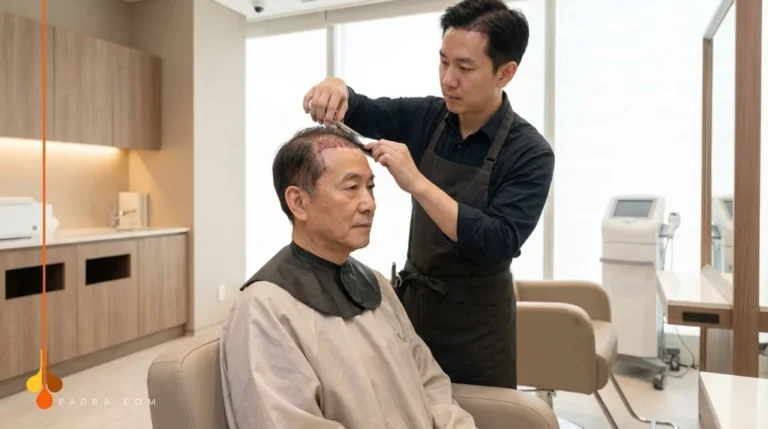
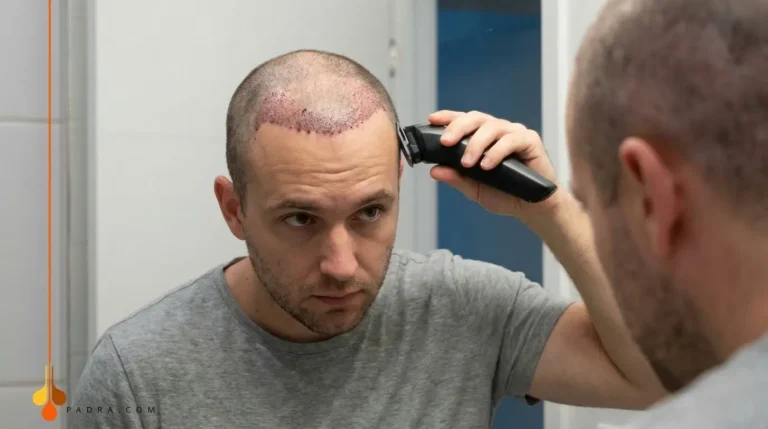
Seeing low density 7 months after a hair transplant is often normal and usually reflects hair immaturity, not failure. At this stage, many transplanted hairs are still thin, soft, and growing unevenly, which limits visible fullness. True density develops as hair shafts thicken between months 7 and 12. Most patients notice meaningful improvement with time, while final results should only be judged closer to the one-year mark or later.
If you are 7 months after a hair transplant and still notice no density, it’s understandable to feel frustrated. Many patients reach this point expecting their hair to look fuller, and it can be disappointing when the results don’t yet match what they imagined.
In reality, this stage often causes more worry than it needs to. Hair growth and hair density do not happen at the same pace. Seeing hair grow does not always mean it will look thick right away. This guide explains why density can still look low at this stage, what changes usually happen next, and when it may be helpful to get a professional opinion—without fear or unrealistic expectations.
Understanding the Gap Between Growth and Density
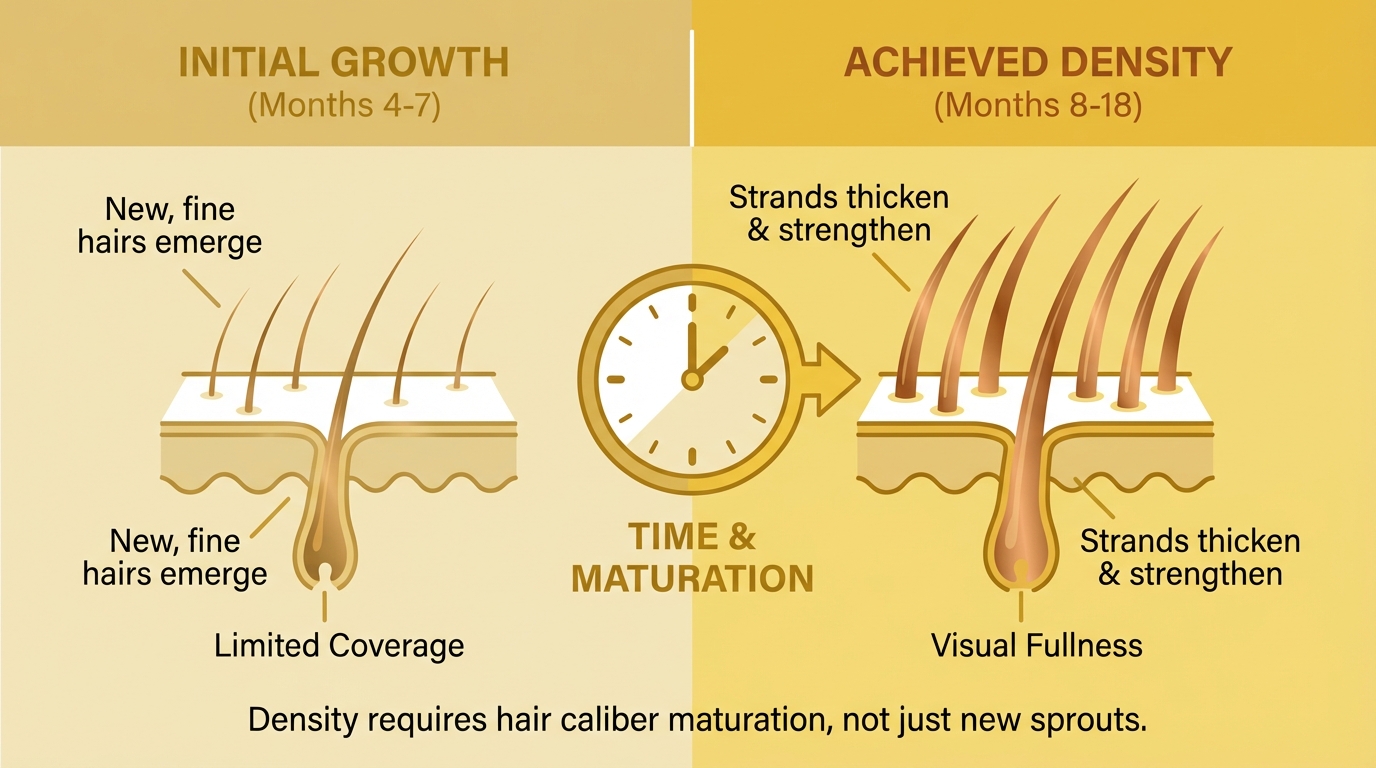
Growth marks the physical emergence of new hairs, but density is defined by their thickness and coverage. In the months following a transplant, new hairs often debut as fine, soft strands. Because they lack an initial diameter, they provide minimal visual fullness at first, even if the count of new hairs is high.
True density is a result of follicular maturation. Over time, these individual hairs gradually thicken and strengthen, moving from a delicate “baby hair” texture to their permanent, robust form. This increase in hair caliber has a much greater impact on your final appearance than the number of hairs alone.
Because follicles follow a strict biological timeline, it is perfectly normal for early results to appear sparse. Significant density typically develops between 6 and 12 months as the hair shafts reach their full diameter and provide the structural coverage required for a successful, natural look.
Is Low Density Normal at 5 to 7 Months After a Hair Transplant?
5 months after hair transplant, no density
At five months, many people still see thin, soft hairs or uneven growth. Some areas may look empty, but the follicles are often active under the skin. This stage is very common and usually not a warning sign.
6 months after hair transplant, no density
By six months, more hairs are visible, but they often lack strength and volume. Many patients expect density at this point, but most hair has not thickened yet. Progress can look slow even when things are on track.
7 months after hair transplant, no density
Being 7 months after a hair transplant, no density is still reported by many patients. Hair is often growing, but it has not reached its mature size. Patchy areas, thin coverage, and see-through spots can still be part of normal recovery.
What is still developing at this stage:
- Hair thickness
- Even growth across the scalp
- Better blending with existing hair
What Often Improves Between Months 7 and 9
Thicker hair strands
Between months seven and nine, hair shafts usually become stronger and wider. This single change can make hair look much fuller, even without new hairs appearing.
Better overall coverage
As more hairs mature at the same time, thin areas begin to blend. The scalp becomes less visible, especially in normal lighting.
9 months after hair transplant, no density
Some patients still report 9 months after hair transplant no density, but this does not always mean failure. If hair is present and slowly thickening, improvement may continue. However, lack of any visible growth by this stage should be checked by a professional.
Common Reasons Density Still Looks Low
At this stage, low density does not always mean something is wrong. In many cases, the hair is still changing in ways that are not easy to see yet. Several normal factors can make transplanted hair appear thinner than it really is:
- Hairs are still thin:
Early transplanted hairs usually grow fine and soft. Even when many hairs are present, they do not add much volume until they thicken over time. - Uneven growth timing:
Not all follicles wake up at the same time. Some hairs grow earlier, while others remain in a resting phase. This uneven timing can create patchy or sparse-looking areas. - Hair direction or curl:
Transplanted hair may grow at a different angle or have a slight curl compared to your natural hair. This can affect how well the hair covers the scalp, especially in certain lighting. - Lighting and hair styling:
Bright lights, overhead lighting, and flat hairstyles can make the scalp more visible. In many cases, the hair looks fuller in softer light or with simple styling changes.
Together, these factors often make density look worse than it truly is during the mid-recovery phase.
When Should Low Density Be Checked by a Professional?
You should consider a professional review if:
- Large areas show no growth at all by 9–12 months
- The scalp feels painful, red, or irritated long after healing
- There is no sign of hair thickening over time
Judging results too early can cause unnecessary worry. Many patients who panic at 6 or 7 months later see strong improvement with patience.
But if you want to know more about How to Hide a Hair Transplant, click and read the article.
Can Hair Density Still Improve After 9 Months?
Yes. Many patients continue to see changes up to 12 months and sometimes longer. Hair continues to mature, gain strength, and cover the scalp better. This is why most clinics do not judge final results too early.
Patience plays a major role in hair transplant recovery.
Simple Ways to Improve the Look of Density Right Now
Styling choices
- Keep hair slightly longer during this phase
- Use light volumizing products
- Avoid heavy gels that flatten hair
Hair care habits
- Be gentle with the scalp
- Follow the washing and care advice from your clinic
- Support hair health with good nutrition and sleep
Follow your clinic’s guidance
Only use treatments like minoxidil or PRP if recommended by your provider. Avoid adding products on your own without advice.
Calm Expectations Lead to Better Decisions
Feeling concerned about 5 months after hair transplant, no density, 6 months after hair transplant no density, or 7 months after hair transplant no density is very common. In most cases, density improves as hair thickens and matures over time.
The key is balance: stay patient, but do not ignore real warning signs. A calm, professional review is always better than guessing based on online photos.