






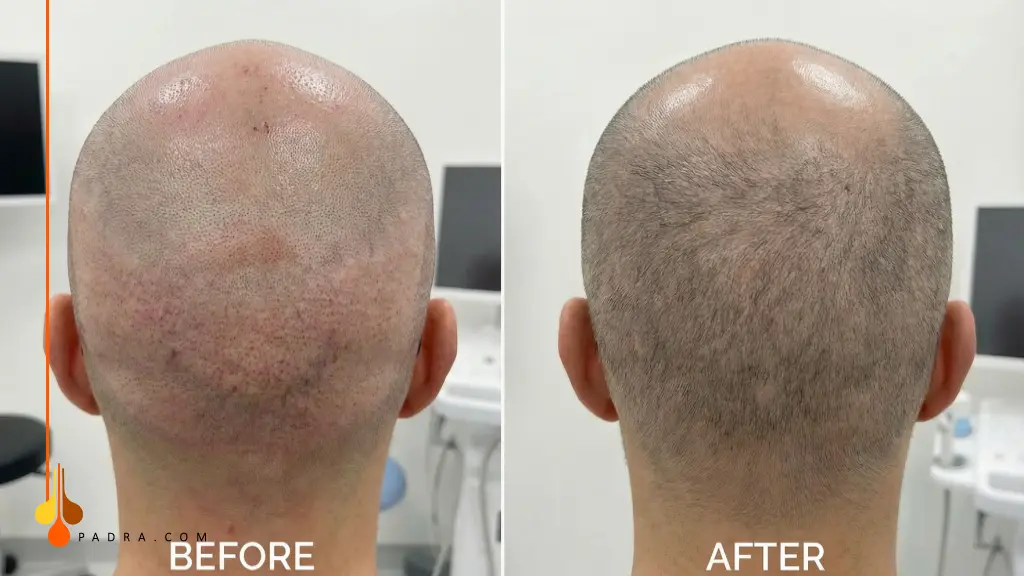
The FUE donor area is the patch of scalp, typically on the back and sides of your head, where surgeons harvest hair follicles for transplanting. People call it the “permanent zone” because those hairs are genetically more resistant to balding — they tend to keep growing even after being moved to thinning spots.
In an FUE procedure, a surgeon doesn’t take a strip of skin. Instead, they remove single follicles one at a time with a tiny punch tool. That’s why, after healing, you’ll usually see only lots of tiny dot marks rather than one long scar. From a distance — or with hair grown out a bit — those little dots are hard to notice.
Removed follicles do not grow back, but surrounding hairs usually stay healthy, keeping the donor area looking dense. Initial redness or scabs heal within about two weeks, and the area typically looks natural and settled after a year.
Good donor-area planning matters. An experienced surgeon will harvest conservatively so you don’t end up with visible thinning where grafts were taken. That planning also keeps options open if you want another session later.
Do Donor Hairs Grow Back? Let’s Clear Up the Confusion
Many people ask, “do donor hairs grow back?” or “does donor hair grow back?” The clear answer: the specific follicles taken do not regrow. When a follicle is removed, it’s gone. So, does the donor area grow back? Not the same follicles, but the donor area usually looks normal because remaining hairs fill in and extraction dots are tiny.
If you’re wondering does hair regrow in donor area after FUE hair transplant, the short answer is no for the removed roots, but yes for overall appearance. Skilled surgeons avoid taking too many grafts from one spot to prevent a thin-looking donor area.
Worried About Donor Area Healing?
Book Your Donor Area Recovery Consultation Today
Donor area recovery timeline
Knowing milestones helps set expectations for hair transplant donor area recovery and answers “what happens to the donor area after hair transplant.”
- First 48–72 hours: Tiny scabs form around extraction points. Mild soreness is normal.
- After 1 week: Many scabs fall off. Redness fades for most people.
- FUE donor area after 2 weeks: Scabs are usually gone and the area looks much better. You may still see faint dot marks when hair is very short.
- 3–4 months: Skin and hair settle; tiny dots are less noticeable.
- Donor area after 1 year: Most patients report a natural, balanced look. Final texture and concealment of extraction points are clear by this time.

This timeline shows why FUE often wins on quick recovery and discrete healing compared to FUT.
How to improve healing in the donor area
If you search “how to improve hair donor area,” these practical steps work:
- Follow the surgeon’s aftercare instructions exactly.
- Don’t pick or scratch scabs — that raises the risk of extra scarring.
- Eat protein-rich foods and drink water; good nutrition aids skin repair.
- Use gentle shampoo once your clinic says it’s safe.
- Avoid heavy exercise and sweating for the first week or as advised.
- Avoid smoking and limit alcohol while healing.
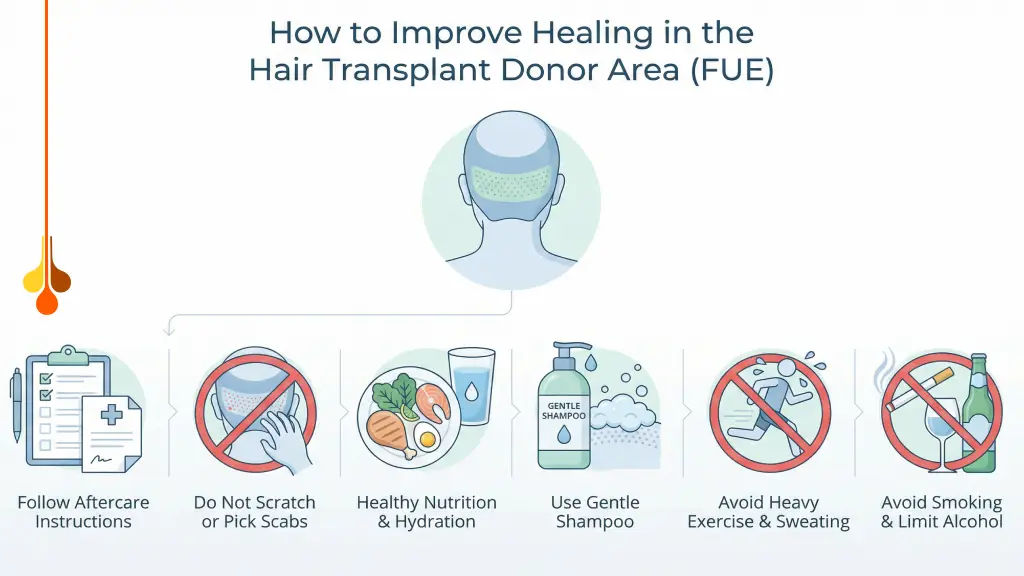
These steps support hair transplant donor area regrowth in appearance and reduce complications.
Contact our clinic today for personalized advice
Benefits and limits of the FUE donor area
Understanding the benefits and limitations of the FUE donor area helps you set realistic expectations and make informed decisions before choosing this hair transplant method.
Benefits
- Tiny, dot-like scars are created during FUE, and they are usually so small that most people cannot notice them, even with short hair.
- Recovery is faster and less painful compared to FUT, so you can return to normal activities sooner.
- FUE allows flexibility for multiple small sessions if more grafts are needed later, without leaving a large scar.
- When performed by an experienced surgeon, the donor area heals naturally and blends in with surrounding hair.
Limitations
- The hair follicles that are removed do not grow back, so surgeons must plan carefully to avoid over-extraction.
- Taking too many follicles from one area (over-harvesting) can make the donor site look thinner permanently.
- People with advanced hair loss may have a limited supply of donor hair, which can restrict how much can be transplanted.
- The final results depend heavily on the skill and experience of the surgeon performing the procedure.
If you worry about future work, ask your surgeon how many grafts can be safely taken now and later.
Want a Natural, Scar-Free Look?
Schedule a Consultation with a Specialist
Results & realistic expectations
Expect tiny scabs to vanish within days and steady improvement over weeks. The final appearance of the donor area often becomes clear by 8–12 months. If you ask, will the density look thinner after extraction? — if the surgeon is conservative, density stays natural. If too many follicles are removed, thinning can be permanent.
| Feature | FUE donor area | FUT donor area |
| Scar type | Tiny dot scars | Single linear scar |
| Recovery speed | Faster | Slower |
| Visibility with short hair | Low | Higher |
| Best for | Discreet scarring, staged sessions | Large graft needs in one session |
| Reuse for future | Better if conservative | Depends on strip scar |
Why Understanding Your Donor Area Matters
The FUE donor area plays a central role in every hair transplant, and understanding how it heals, how density changes, and how to care for it helps you make confident decisions. While removed donor hair follicles do not grow back, the donor site usually keeps a natural look when an expert surgeon uses careful planning and balanced extraction. Healing is fast, and most people see the donor area blend in smoothly within weeks, with the final look settling by the end of the first year.
With proper care, smart graft planning, and realistic expectations, the donor area stays healthy, steady, and ready for future needs if your surgeon says you have enough supply. If you are preparing for a hair transplant, take your time to learn how your donor area works — it’s the foundation of long-lasting, natural-looking results.
Curious If Donor Hairs Grow Back?
Get Expert Advice on FUE Donor Area