






Let’s be honest: Deciding to get a hair transplant is a huge step. But once you commit, you run right into the next, even tougher question: Should I get FUE or FUT?
Both are proven, effective ways to get your hair back, but they are dramatically different surgeries with different results for your budget, recovery, and most importantly, your scar.
What Is FUE and FUT?
The main difference between FUE and FUT is all about the harvest—how your doctor collects the healthy hair roots (grafts) from the back of your scalp before implanting them.
Book Your Hair Assessment Today
What Is FUE? (Follicular Unit Extraction)
Think of FUE Hair Transplant as the precision, modern approach. It’s hands-down the most popular choice today.
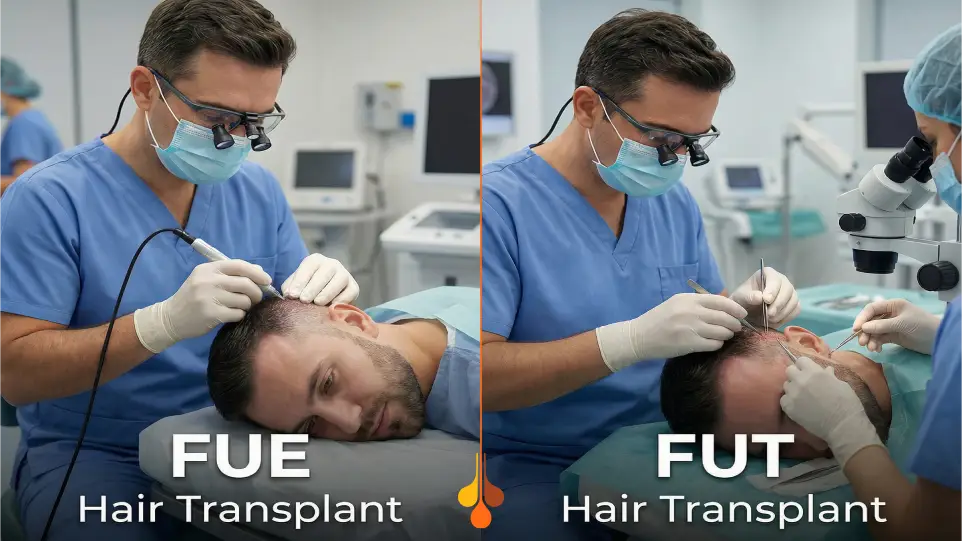
- The Process: The surgeon uses a tiny punch tool (less than 1 millimeter wide) to carefully extract individual hair follicles one by one.
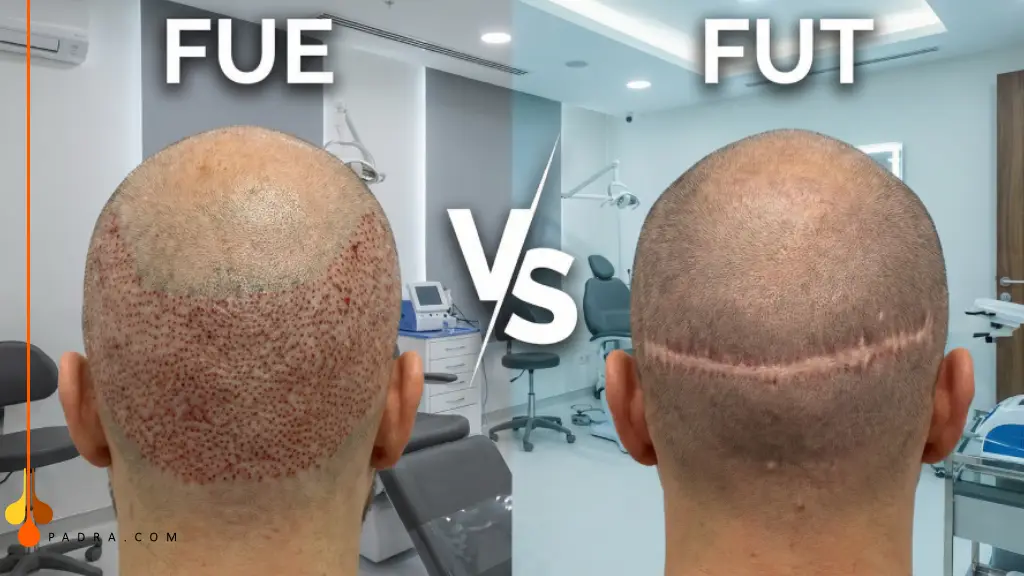
- The Donor Area: Because the grafts are taken individually and spread out, you’re left with thousands of tiny, dot-like scars that are practically invisible once healed. There’s no big cut or stitch line.
- Best For: Patients who like to wear their hair short or even shaved.
- The Catch: It’s more time-consuming because of the meticulous, graft-by-graft harvesting.
What Is FUT? (Follicular Unit Transplantation)
If you’re wondering what is FUT, it’s the traditional method, sometimes called the “strip method.” It’s highly effective for covering large areas.
- The Process: The surgeon removes one thin strip of skin from the back of the scalp. Technicians then carefully dissect this strip under microscopes to get thousands of perfect individual grafts.
- The Donor Area: The area where the strip was removed is then stitched up, leaving a single, thin linear scar.
- Best For: Getting the maximum number of grafts in a single session.
- The Catch: You must wear your hair long enough to cover that line scar.
FUE vs FUT: Key Differences
Here is the quick breakdown of the FUT vs FUE transplant differences:
| Factor | FUE | FUT |
| Scarring | Micro-dot scars (scattered) | Linear scar (a single line) |
| Recovery | Faster (usually less than a week) | Longer (up to two weeks for stitches) |
| Cost | Higher per graft | More affordable |
| Pain | Minimal discomfort/soreness | Slightly more discomfort (due to stitches/tension) |
| Graft Yield | Moderate (up to 3,000 per day) | High (can easily reach 4,000+ per day) |
| Best For | Short hairstyles, minimal scarring | Large areas, maximum graft count |
| Downtime | Low | Moderate |
The Details That Really Matter
When patients ask, FUE vs FUT, which is better, they’re really asking about three things: the money, the mark it leaves, and the outcome.
FUE vs FUT: Cost Comparison
- FUE costs more because it’s a high-labor, high-time commitment. The individual extraction of each follicle takes serious focus, advanced technology, and much more time in the operating room. This translates directly to a higher price per graft.
- FUT, on the other hand, is usually more affordable per graft. The strip method lets the surgeon harvest a massive number of grafts quickly, making the procedure more cost-efficient when you need a high volume of hair moved.
Keep in mind: The total price will always depend on how many grafts you need.
FUE vs FUT: Scarring Differences
This is often the dealbreaker. The way the FUE vs FUT scar heals will determine your hairstyle options forever.
- FUE Scars: FUE leaves those little dot-like scars we talked about. Because they are tiny and spread all over the back of the head, they’re typically impossible to spot, even if you cut your hair with a clipper guard of ‘1’ or ‘0’.
- FUT Scars: The FUT hair transplant difference is the straight-line scar. While a great surgeon will make this scar pencil-thin, it’s still a linear mark. You must commit to a longer hairstyle to conceal it. If you ever want a buzz cut, you should choose FUE.
Success Rates & Results
Will the hair actually grow? The good news is that both techniques offer similar, excellent results.
- FUE vs FUT success rate: With a skilled surgical team, both methods deliver fantastic graft survival rates—usually well over 90%. The transplanted hair is permanent because it comes from the area on your head that’s genetically resistant to balding.
- FUE vs FUT hair transplant results: Both can look completely natural. FUE is sometimes used for the most refined natural hairlines because of its precision.
Recovery Time & Healing
How fast can you get back to work and life?
- FUE recovery is quicker. Since there are no stitches or big cuts, the donor area heals fast. You’ll have scabs, but most people are comfortable going back to work within 3–5 days, and all signs of the procedure (other than the growing hair!) are typically gone after a week.
- FUT recovery is slightly longer. The linear incision needs time to heal. You’ll have stitches or staples that stay in for about 10–14 days. You’ll need to avoid difficult activities and anything that stretches the scalp for at least two weeks to ensure the scar heals as thin as possible.
Schedule Your Expert Consultation
Which Method Is Better?
Neither FUE nor FUT is universally better. The ideal choice is always dictated by your unique needs.
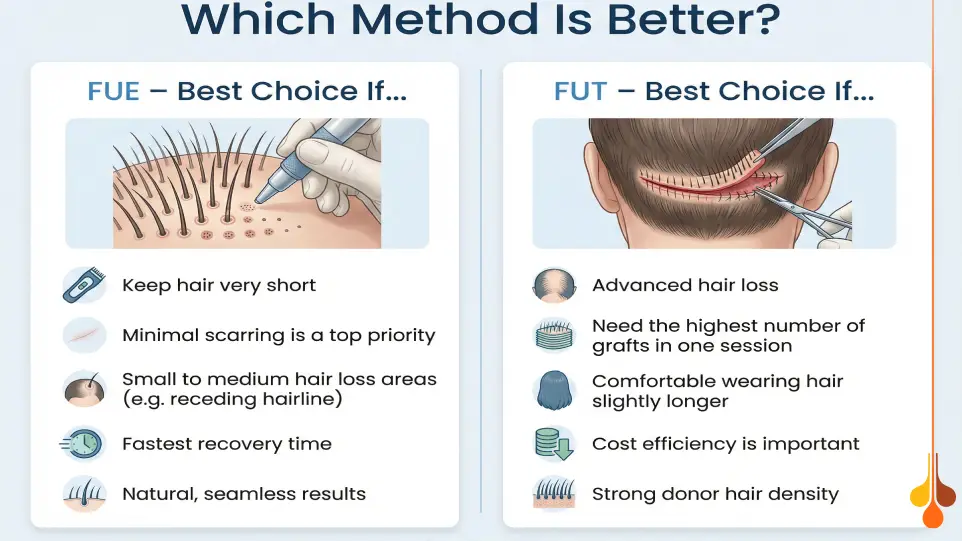
FUE is Better for You if…
- You insist on keeping your hair very short.
- You are prioritizing the most minimal scarring possible.
- You only need a small–medium area of hair loss filled in (like a receding hairline).
- You need the absolute fastest recovery time.
FUT is Better for You if…
- You have advanced hair loss and need the highest possible number of grafts in one session.
- You don’t mind wearing your hair a little longer (enough to cover the thin scar).
- You are prioritizing cost efficiency for a large procedure.
- You have excellent donor hair density.
The Final Takeaway
The debate isn’t truly about FUE vs FUT, which is better—it’s about which method is right for your unique case. Both techniques are highly effective and offer long-lasting, natural results.
The most critical step you can take now is to consult with an expert surgeon who performs both procedures. They will look at your degree of hair loss, your donor hair quality, and your life goals to recommend the perfect path forward.