
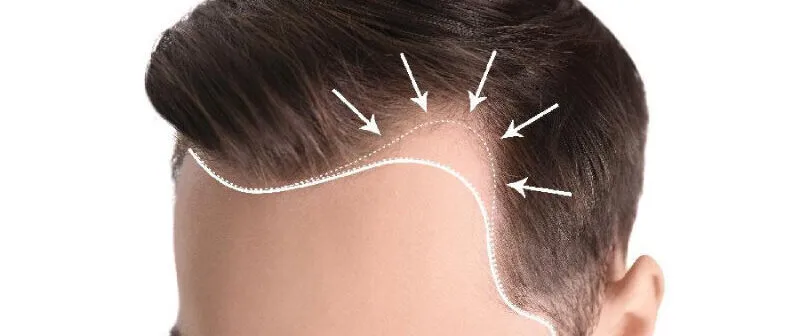
- Hairline surgery men—options, results, what to expect: Proportion-first men’s hairline restoration with a natural, age-fit edge.
- Main choices: Hair transplant for receding hairline vs male forehead reduction surgery.
- Lowering limits: Hair transplant to lower hairline is modest; over-lowering can look unnatural.
Key risks: Shock loss, scarring, future recession; best fit needs stable loss and a strong donor.
Hairline Surgery Men: Options, Results, and What to Expect
Hairlines shift quietly, and then, one day, the mirror feels loud. For men in the Norwood 2–4 range, hairline surgery men options can correct recession, improve framing, and restore proportion—without chasing a “perfect” edge that won’t age well. The safest plans treat the hairline as architecture: a clear front, a soft transition, and enough reserve for whatever comes next.
What Is Hairline Surgery in Men?
In clinical terms, hairline surgery for men covers procedures that restore or modify the frontal hairline for cosmetic balance. Two broad paths exist.
Transplant-based restoration uses follicles from a stable donor zone to rebuild a hair transplant hairline with natural angles and a feathered edge. This is often described as men’s hairline restoration when the goal is a mature frame rather than teenage density.
Surgical lowering shifts the scalp forward to reduce forehead height (scalp advancement/forehead reduction).
Both can be considered “new hairline surgery,” but the mechanics differ: one adds hair gradually; the other moves tissue immediately. Choice depends on hair-loss stability, donor supply, scalp laxity, and scar tolerance.

Hair Transplant for Receding Hairline
A hair transplant for a receding hairline rebuilds the front using follicles that follow “donor dominance,” meaning transplanted hairs tend to keep their original traits after relocation. The work is precise: micro-grafts placed to mimic nature, not paint.
A well-planned receding hairline transplant usually follows three principles:
First, the leading edge stays soft with single-hair grafts and slight irregularity.
Second, density ramps up behind the edge, where fullness reads naturally.
Third, the position stays age-appropriate—often the difference between a credible receding hair transplant and a line that looks “done.”
The technique mainly affects donor management. Follicular Unit Extraction (FUE) removes individual grafts; Follicular Unit Transplantation (FUT) removes a strip and typically leaves a fine-line scar hidden by hair.
| Technique | How grafts are taken | Typical donor mark | Best fit |
| FUE | Individual follicular units | Tiny dot scars | Short styles, selective sessions |
| FUT | Strip harvest + dissection | One linear scar | Larger graft counts |
A transplant restores shape first, then density. In early recession, a modest density plan in the forelock and frontal zone can change the whole silhouette, while leaving grafts in reserve for later.
Hair Transplant to Lower Hairline — Is It Possible?
A hair transplant to lower the hairline is possible, but “lower” needs limits. A transplant can move the apparent line forward modestly—often enough to shorten a forehead visually—without creating a low, heavy edge.
Over-lowering can look unnatural, consumes donor supply fast, and leaves less reserve for future recession. Conservative lowering guided by facial proportion tends to age better than aggressive moves. Even small changes are usually designed with temple recession in mind, since temples often continue to drift with time.
Forehead Hair Transplant vs Male Forehead Reduction Surgery
This is the main fork: forehead hair transplant (adding follicles) versus male forehead reduction surgery (moving scalp). A transplant can be built with forehead hair implants along the front, improving framing over months. Forehead reduction—also called hairline lowering or scalp advancement—removes a strip of forehead skin and advances the hair-bearing scalp forward.
Forehead reduction is more invasive and can involve a hairline scar and temporary numbness that often improves with time. Transplantation is less invasive in that sense, yet limited by donor supply and cannot move the entire scalp forward.
| Option | What changes | Speed | Trade-offs |
| Forehead hair transplant | Adds hair at the front | Gradual | Limited lowering; donor limits |
| Male forehead reduction surgery | Advances scalp forward | Immediate | Scar risk, numbness, laxity limits |
Candidate selection differs. Forehead reduction favors stable hairlines and sufficient scalp laxity; ongoing pattern loss can create recession behind the advanced line. In practice, some plans combine approaches: surgical advancement for immediate lowering, then grafting later to soften the scar line or reinforce corners.
Receding Hairline Surgery — Who Is a Good Candidate?
The term receding hairline surgery may refer to transplant-based restoration or surgical lowering. Good candidacy is usually uncomplicated.
Strong candidates
- Stable pattern hair loss
- Dense, stable donor zone
- Realistic expectations on density
Higher-risk candidates
- Diffuse thinning with a weak donor
- Rapid ongoing recession
- “Perfect,” low, straight hairline goals
Candidacy is also about sequencing. Younger men with early recession often benefit from a staged plan that preserves donor supply and keeps the design conservative. Overdesign can look sharp in year one and odd in year five.
What Natural Men’s Hairline Restoration Looks Like
Natural men’s hairline restoration is defined by restraint: a soft, irregular edge; single-hair grafts in the first rows; gradual thickening behind; and temple work that frames without looking sharp. Density illusion—angle, direction, and spacing—often matters more than extreme packing.
Results and Recovery: What to Expect
Hairline work is not “instant hair,” even when the change is visible early. Transplants typically shed the visible hairs from grafts before regrowth begins; Cleveland Clinic notes that graft hairs often fall out after surgery and may not regrow for about three months. Forehead reduction changes position immediately, but swelling and scar maturation still take time.
A practical timeline often looks like this:
- Transplant (first month): redness, small scabs, and a settling phase.
- Transplant (months 2–4): shedding then early regrowth; coverage starts to return.
- Transplant (months 6–12): thickening and refinement; hairline looks more “finished.”
- Forehead reduction (early weeks): swelling and tightness; incision care is part of recovery.
- Forehead reduction (months): scar softens and sensation can gradually return; numbness after forehead surgery can take months to fully fade in some cases.
The “final” look is usually judged after scar and growth have matured, not in the early postoperative window.
Risks and Limitations of Hairline Surgery
Hairline work has real limits that deserve plain language.
- Shock loss: temporary shedding can occur after transplantation; native hairs in fragile zones may shed as well.
- Future recession behind the work: grafts may stay, but surrounding hair can continue to thin.
- Scarring: FUT leaves a linear donor scar; forehead reduction leaves a hairline scar designed to camouflage, but healing varies.
- Revision risk: over-lowered or over-dense designs are harder to soften later.
Final Thoughts — Is Hairline Surgery the Right Choice?
The most reliable outcomes come from restraint. For hairline surgery men, design usually matters more than brute density: a soft edge, a mature position, and a plan that anticipates future recession. Transplant-based work can rebuild the recession gradually; surgical lowering can reduce forehead height quickly in selected candidates. Both can look natural when anatomy and long-term progression drive the decision.